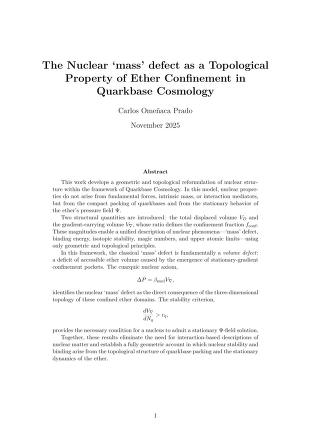
The Nuclear mass defect as a Topological Property of Ether Confinement in Quarkbase Cosmology develops a geometric and topological reformulation of nuclear structure within the framework of Quarkbase Cosmology. In this model, nuclear properties do not arise from fundamental forces, intrinsic mass, or interaction mediators, but from the compact packing of quarkbases and from the stationary behavior of the ether’s pressure field Ψ. Two structural quantities are introduced: the total displaced volume V D and the gradient-carrying volume V ∇ , whose ratio defines the confinement fraction f conf. These magnitudes enable a unified description of nuclear phenomena-‘mass’ defect, binding energy, isotopic stability, magic numbers, and upper atomic limits-using only geometric and topological principles. In this framework, the classical ‘mass’ defect is fundamentally a volume defect: a deficit of accessible ether volume caused by the emergence of stationary-gradient confinement pockets. The cuarquic nuclear axiom, ∆P = β nucl V ∇ , identifies the nuclear ‘mass’ defect as the direct consequence of the three-dimensional topology of these confined ether domains. The stability criterion, dV ∇ dN q > v q , provides the necessary condition for a nucleus to admit a stationary Ψ-field solution. Together, these results eliminate the need for interaction-based descriptions of nuclear matter and establish a fully geometric account in which nuclear stability and binding arise from the topological structure of quarkbase packing and the stationary dynamics of the ether.
Date: Nov 30, 2025
Author: Carlos Omeñaca Prado
ORCID: https://orcid.org/0009-0001-9750-5827
Resource type: Preprint
Publisher: Zenodo
License: CC BY-SA 4.0 International
Related links:
- https://zenodo.org/records/17772168
- https://archive.org/details/the-nuclear-volume-defect-as-a-topological-property-of-ether-confinement-in-quarkbase-cosmology
- https://www.academia.edu/145262243/The_Nuclear_mass_defect_as_a_Topological_Property_of_Ether_Confinement_in_Quarkbase_Cosmology