Emergence of the Cosmic Microwave Background in Quarkbase Cosmology

the Cosmic Microwave Background

The cosmic microwave background (CMB) presents an alternative derivation within Quarkbase Cosmology, where the physical vacuum is modeled as a continuous, frictionless medium described by a scalar pressure field Ψ. Starting from a single variational principle, the linear dynamics of the Ψ-field are derived and shown to admit a unique, dispersionless luminal mode. The statistical mechanics of this mode lead necessarily to a stationary Planckian distribution, identified with the observed CMB. The blackbody spectrum, its temperature, and its global isotropy follow as direct consequences of medium dynamics, without invoking primordial thermal equilibrium, inflation, recombination, or an expanding metric. Temperature anisotropies arise as linear transport effects induced by spatial variations of the medium, while cosmological redshift is obtained as an intrinsic temporal evolution of the vacuum that preserves the Planckian spectral form exactly. The resulting framework reproduces all kinematic observational properties of the CMB, eliminates the horizon problem by construction, and yields a self-consistent, falsifiable, non-expanding description grounded in a single physical ontology.

DOI: 10.5281/zenodo.18028189

Date: Dec 23, 2025

Author: Carlos Omeñaca Prado
ORCID: https://orcid.org/0009-0001-9750-5827

Resource type: Preprint
Publisher: Zenodo
License: CC BY-SA 4.0 International

Related links:

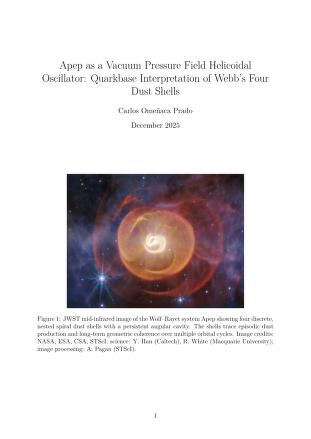
Apep as a Vacuum Pressure Field Helicoidal Oscillator: Quarkbase Interpretation of Webb’s Four Dust Shells

Apep as a Vacuum Pressure Field Helicoidal Oscillator

Apep as a Vacuum Pressure Field Helicoidal Oscillator presents a geometry-driven physical interpretation of the Wolf–Rayet system Apep based on recent JWST mid-infrared observations resolving four discrete spiral dust shells. The shell discreteness, preserved phase coherence, and persistent angular cavity indicate long-period, phase-locked dynamics inconsistent with steady-state or turbulent outflow models. Within the framework of Quarkbase Cosmology, the circumstellar environment is treated as a low-dissipation continuous medium capable of sustaining coherent helicoidal modes, with dust acting as a passive tracer of phase-coherent propagation. The work derives clear, falsifiable observational predictions and maintains a strict separation between observational facts and theoretical interpretation

DOI: 10.5281/zenodo.17925340

Date: Dec 14, 2025

Author: Carlos Omeñaca Prado
ORCID: https://orcid.org/0009-0001-9750-5827

Resource type: Preprint
Publisher: Zenodo
License: CC BY-SA 4.0 International

Related links:

Cosmological Redshift Without Expansion: The Quarkbase Cosmology Explanation

Cosmological Redshift Without Expansion

Cosmological Redshift Without Expansion presents a physical reinterpretation of cosmological redshift within the framework of Quarkbase Cosmology. In contrast to the standard geometric interpretation based on expanding space, the redshift is explained as a consequence of the evolution of a real physical medium, the Ψ-field, which underlies light propagation and local measurement processes.

Light is described as a non-dissipative luminal resonant mode of this medium, while frequency is defined operationally through its coupling to local material resonators. The redshift is shown to arise from differences between the state of the Ψ-field at emission and observation, summarized by the relation:

1 + z = n(tobs) / n(temit)

This approach reproduces the observed redshift–distance relation without invoking expanding space, accelerated cosmic expansion, or dark energy, and reframes cosmological redshift as a direct probe of the physical state and temporal evolution of the universe’s underlying medium.

DOI: 10.5281/zenodo.17917488

Date: Dec 12, 2025

Author: Carlos Omeñaca Prado
ORCID: https://orcid.org/0009-0001-9750-5827

Resource type: Preprint
Publisher: Zenodo
License: CC BY-SA 4.0 International

Related links:

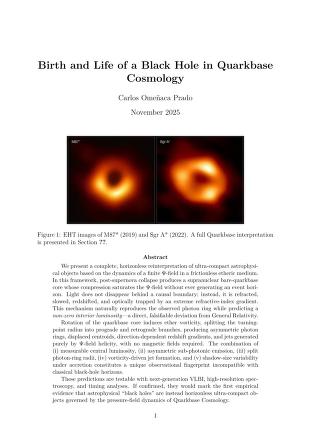
Birth and Life of a Black Hole in Quarkbase Cosmology

Birth and Life of a Black Hole in Quarkbase Cosmology

Birth and Life of a Black Hole in Quarkbase Cosmology presents a complete, horizonless reinterpretation of astrophysical black holes within the Quarkbase Cosmology framework. Instead of forming an event horizon or singularity, post-supernova collapse produces a supranuclear quarkbase core whose extreme compression saturates the Ψ-field. The resulting ultra-compact object traps and bends light through a steep refractive-index gradient, not through spacetime curvature. The theory reproduces all major observational features attributed to black holes—photon rings, brightness asymmetry, jet formation, and shadow morphology—without invoking horizons. Light is optically trapped, strongly redshifted, and partially re-emitted, generating a faint but non-zero interior luminosity. Rotation of the quarkbase core induces ether vorticity, splitting the turning-point radius into prograde and retrograde branches, producing displaced ring centroids, asymmetric brightness distributions, and vorticity-driven jets without magnetic fields. The model yields a suite of falsifiable predictions: – non-zero interior luminosity (10⁻⁵–10⁻³ of ring brightness), – split photon-ring radii, – ring-centroid displacement independent of Kerr geometry, – jet formation without magnetic fields, – shadow-size variability under accretion, – and sub-photonic emission leaking from the trapping region. These signatures distinguish horizonless quarkbase objects from classical GR black holes and can be tested with next-generation VLBI, high-resolution spectroscopy, and timing analyses.

DOI: 10.5281/zenodo.17750181

Date: Nov 28, 2025

Author: Carlos Omeñaca Prado
ORCID: https://orcid.org/0009-0001-9750-5827

Resource type: Preprint
Publisher: Zenodo
License: CC BY-SA 4.0 International

Related links:

The Fatal Paradox of Classical Physics in Black Holes

The Fatal Paradox of Classical Physics in Black Holes

The Fatal Paradox of Classical Physics in Black Holes formulates one of the deepest and least acknowledged contradictions in classical black-hole physics: the “singularity of the parts.” General relativity predicts that an event horizon forms at the Schwarzschild radius, and that every material element inside must reach the singularity in finite proper time. But once the horizon exists, no extended body can remain coherent across the interior region. Each “part” of the collapsing object follows its own causal destiny toward r = 0, destroying the notion of a continuous body long before reaching the central singularity. This produces an ontological discontinuity inside classical GR: the theory preserves the metric mathematically, but destroys the physical category of “matter” needed to interpret that metric. The interior of a black hole cannot contain an extended object, cannot preserve simultaneity of its parts, and cannot maintain relativistic invariance. The collapse becomes undefined as a physical process, even though the equations remain formally valid. The work shows that GR offers no continuous macroscopic state between the event horizon and r = 0—only a collection of worldlines that terminate independently. The standard narrative “the star contracts until it becomes a point” is physically impossible, because the star ceases to exist as a body before the singularity is reached. The paper then explains how this paradox is resolved in Quarkbase Cosmology: by replacing the empty interior with a continuous plasmatic ether medium (Ψ-field) that preserves global coherence, halts collapse at a finite radius, and removes the singularity entirely. This reinterpretation restores physical continuity and turns the black-hole interior into a well-defined state of confined etheric pressure.

DOI: 10.5281/zenodo.17716912

Date: Nov 18, 2025

Author: Carlos Omeñaca Prado
ORCID: https://orcid.org/0009-0001-9750-5827

Resource type: Preprint
Publisher: Zenodo
License: CC BY-SA 4.0 International

Related links:

3I ATLAS explained

3I ATLAS explained

3I ATLAS explained reinterprets quasars within the Quarkbase Cosmology framework as large-scale resonators of the etheric plasma field Ψ, rather than mere products of gravitational accretion. In this model, the extreme luminosity of quasars arises from quark–gluon reconfiguration occurring in the inner regions of active galactic nuclei, where matter approaching a supermassive black hole reaches densities close to the quark–gluon critical threshold. The theory introduces a quarkbase correction factor ΦQ that amplifies the standard accretion luminosity when the local excitation density ρq approaches the critical density ρcrit, providing a natural explanation for the exceptional brightness of quasars without invoking exotic efficiencies or fine-tuned mechanisms. Quasars are therefore interpreted as cosmic converters: macroscopic windows where microscopic quark dynamics interact with cosmological-scale structures. Their emission becomes a direct observational signature of phase-transition physics usually accessible only in early-universe conditions. The model yields clear implications for cosmology, suggesting that quasars can function as testbeds for quark–gluon transitions, etheric-plasma behavior, and energy-conversion processes predicted by Quarkbase Cosmology.

DOI: 10.5281/zenodo.17717913

Date: Nov 16, 2025

Author: Carlos Omeñaca Prado
ORCID: https://orcid.org/0009-0001-9750-5827

Resource type: Preprint
Publisher: Zenodo
License: CC BY-SA 4.0 International

Related links:

Quasars in the Framework of Quarkbase Cosmology

Quasars in the Framework of Quarkbase Cosmology

Quasars in the Framework of Quarkbase Cosmology reinterprets quasars within the Quarkbase Cosmology framework as large-scale resonators of the etheric plasma field Ψ, rather than mere products of gravitational accretion. In this model, the extreme luminosity of quasars arises from quark–gluon reconfiguration occurring in the inner regions of active galactic nuclei, where matter approaching a supermassive black hole reaches densities close to the quark–gluon critical threshold. The theory introduces a quarkbase correction factor ΦQ that amplifies the standard accretion luminosity when the local excitation density ρq approaches the critical density ρcrit, providing a natural explanation for the exceptional brightness of quasars without invoking exotic efficiencies or fine-tuned mechanisms. Quasars are therefore interpreted as cosmic converters: macroscopic windows where microscopic quark dynamics interact with cosmological-scale structures. Their emission becomes a direct observational signature of phase-transition physics usually accessible only in early-universe conditions. The model yields clear implications for cosmology, suggesting that quasars can function as testbeds for quark–gluon transitions, etheric-plasma behavior, and energy-conversion processes predicted by Quarkbase Cosmology.

DOI: 10.5281/zenodo.17717220

Date: Sept 09, 2025

Author: Carlos Omeñaca Prado
ORCID: https://orcid.org/0009-0001-9750-5827

Resource type: Preprint
Publisher: Zenodo
License: CC BY-SA 4.0 International

Related links:

Geometry of Galaxies Explained by Quarkbase Cosmology

Geometry of Galaxies Explained by Quarkbase Cosmology

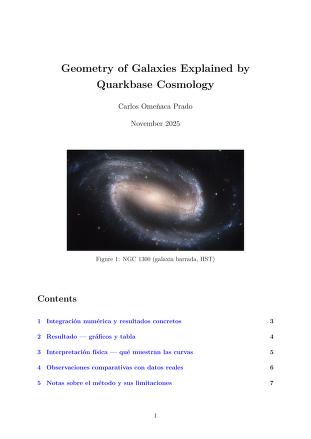
Geometry of Galaxies Explained by Quarkbase Cosmology presents a fully quantitative and physical explanation of galactic geometry within the Quarkbase Cosmology framework. Instead of treating galaxies as gravitationally bound aggregations of matter requiring dark-matter halos, the model interprets them as coherent helicoidal pressure structures generated in a frictionless etheric plasma (Ψ-field) by the long-term motion of a compact quarkic nucleus or black hole. The key mechanism is the superposition of pressure waves produced by simultaneous rotation, translation, and precession of the central compact object. This motion imprints a stable helicoidal pattern in the ether, and the visible galaxy is simply the stationary trace of that pattern. Spiral arms, bars, rings, ellipsoidal shapes, and irregular structures emerge naturally from the kinematic regime: rotation-dominated → spiral galaxies rotation ≈ translation + precession → barred spirals translation-dominated → ellipticals and lenticulars strong precession → rings, polar structures, double cores multi-source interference → irregular galaxies A full numerical integration of rotation curves using a Yukawa-screened pressure potential is presented. Screening lengths of several tens of kiloparsecs reproduce the flat rotation curves of real spiral galaxies without invoking any form of dark matter. The model yields concrete, falsifiable predictions linking observable morphology to nucleus kinematics: pitch angle, arm separation, disk thickness, luminosity scaling, and the relation between galactic size and the screening parameter λ. In this framework, a galaxy is not an evolved gravitational structure but a persistent wave pattern in the ether shaped by the motion of its central quarkic core

DOI: 10.5281/zenodo.17716164

Date: Nov 11, 2025

Author: Carlos Omeñaca Prado
ORCID: https://orcid.org/0009-0001-9750-5827

Resource type: Preprint
Publisher: Zenodo
License: CC BY-SA 4.0 International

Related links:

Filamentation and Supercluster Formation in a Three-Phase Etheric Plasma

Filamentation and Supercluster Formation in a Three-Phase Etheric Plasma

Filamentation and Supercluster Formation in a Three-Phase Etheric Plasma develops a full physical explanation of the cosmic web, superclusters, clusters, filaments, and voids using the three-phase behavior of a frictionless etheric plasma displaced by quarkbases. The central idea is that the vacuum behaves as a continuous plasma whose effective dynamics change depending solely on the local displaced-volume fraction. At extremely low displaced volume, the ether behaves as a rigid medium, producing smooth and completely empty voids. As the displaced-volume fraction increases, the plasma enters a liquid-like regime that forms clusters, sheets, and large walls. Once the threshold for compressibility is crossed, the plasma becomes effectively gas-like and collapses into long, thin pressure channels: the cosmic filaments. Where several filaments intersect, the pressure reaches true minima, generating superclusters. The work shows that these three regimes—rigid, liquid-like, and gas-like—are not different substances, but different dynamic responses of the same frictionless plasma. The cosmic web, including its largest structures, emerges naturally from this phase behavior, without dark matter, without gravitational halos, and without metric expansion. The paper explains why superclusters cannot grow beyond roughly 200–300 Mpc, why voids remain perfectly smooth, why galaxy spins align along filaments, why spirals form only in filamentary regions, and why rotation curves flatten without invoking dark matter. The ether’s transition to a filamentary state is shown to be mathematically identical to the formation of smoke filaments, scaled up by dozens of orders of magnitude. This framework provides a single mechanism that explains all large-scale cosmic structure in a coherent, testable, and falsifiable way

DOI: 10.5281/zenodo.17716344

Date: Nov 01, 2025

Author: Carlos Omeñaca Prado
ORCID: https://orcid.org/0009-0001-9750-5827

Resource type: Preprint
Publisher: Zenodo
License: CC BY-SA 4.0 International

Related links: