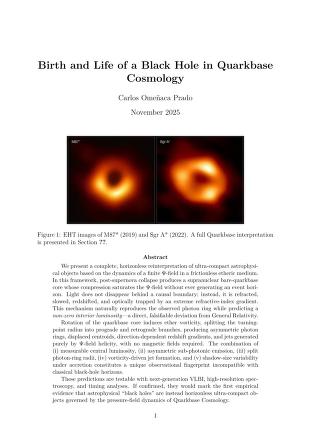
Birth and Life of a Black Hole in Quarkbase Cosmology presents a complete, horizonless reinterpretation of astrophysical black holes within the Quarkbase Cosmology framework. Instead of forming an event horizon or singularity, post-supernova collapse produces a supranuclear quarkbase core whose extreme compression saturates the Ψ-field. The resulting ultra-compact object traps and bends light through a steep refractive-index gradient, not through spacetime curvature. The theory reproduces all major observational features attributed to black holes—photon rings, brightness asymmetry, jet formation, and shadow morphology—without invoking horizons. Light is optically trapped, strongly redshifted, and partially re-emitted, generating a faint but non-zero interior luminosity. Rotation of the quarkbase core induces ether vorticity, splitting the turning-point radius into prograde and retrograde branches, producing displaced ring centroids, asymmetric brightness distributions, and vorticity-driven jets without magnetic fields. The model yields a suite of falsifiable predictions: – non-zero interior luminosity (10⁻⁵–10⁻³ of ring brightness), – split photon-ring radii, – ring-centroid displacement independent of Kerr geometry, – jet formation without magnetic fields, – shadow-size variability under accretion, – and sub-photonic emission leaking from the trapping region. These signatures distinguish horizonless quarkbase objects from classical GR black holes and can be tested with next-generation VLBI, high-resolution spectroscopy, and timing analyses.
Date: Nov 28, 2025
Author: Carlos Omeñaca Prado
ORCID: https://orcid.org/0009-0001-9750-5827
Resource type: Preprint
Publisher: Zenodo
License: CC BY-SA 4.0 International
Related links:
- https://zenodo.org/records/17750181
- https://archive.org/details/Birth_and_Life_of_a_Black_Hole_in_Quarkbase_Cosmology
- https://www.academia.edu/145254498/Birth_and_Life_of_a_Black_Hole_in_Quarkbase_Cosmology