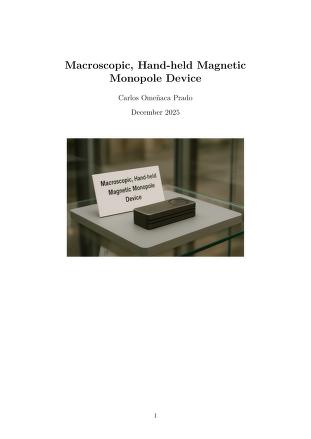
Macroscopic, Hand-held Magnetic Monopole Device

Macroscopic, Hand-held Magnetic Monopole Device

Macroscopic Magnetic Monopole Device presents the first complete engineering blueprint for a physically realizable magnetic monopole within the framework of Quarkbase Cosmology. Building on the interpretation of the magnetic field as etheric vorticity in the Ψ-field, the work demonstrates how displaced Ψ-vortices in twisted bilayer graphene can be phase-aligned and flux-summed to yield a macroscopic, unipolar magnetic output. The device uses thousands of engineered Ψ-modules, each hosting a stabilized vortex with a confined return string, integrated through a ferromagnetic micro-yoke network. A multi-scale collector plate, central flux-chimney, and a fully internal return-manifold channel all compensate flux internally, ensuring that only one external magnetic pole is detectable—while still satisfying ∇·B = 0 at the global level. The full document includes: • detailed physical principles and Quarkbase electrodynamics, • vortex engineering in TBG, • anisotropic stiffness landscapes and strain-pinned vortex cores, • 3D CAD-ready mechanical architecture, • cryogenic system, THz longitudinal-mode pump, phase-coherence strategy, • operational modes, safety constraints, calibration and failure-mode analysis. The result is a 35 mm × 18 mm hand-held solid device that behaves externally as a magnetic monopole and inaugurates the field of Macroscopic Etheric-Topology Devices

DOI: 10.5281/zenodo.17825885

Date: Dec 05, 2025

Author: Carlos Omeñaca Prado
ORCID: https://orcid.org/0009-0001-9750-5827

Resource type: Preprint
Publisher: Zenodo
License: CC0 Open Engineering Specification

Related links:

Effective Graphene Monopole and Its Application to Water Transport

Effective Graphene Monopole

Effective Graphene Monopole and Its Application to Water Transport introduces a fully specified effective graphene-based monopole built on an asymmetric ferromagnetic toroidal core with a curved graphene patch. The device produces a stable pseudo-monopolar field through controlled symmetry breaking, enabling measurable front/back flux imbalance and a near-1/r² radial decay in the frontal hemisphere. A practical application is developed: a water-lifting module capable of moving water without mechanical pumps or moving parts, using only a few watts of electrical power. All geometries, field protocols, and engineering details are released under CC0 to enable immediate humanitarian deployment and open replication.

DOI: 10.5281/zenodo.17823026

Date: Dec 05, 2025

Author: Carlos Omeñaca Prado
ORCID: https://orcid.org/0009-0001-9750-5827

Resource type: Preprint
Publisher: Zenodo
License: CC0 Open Engineering Specification

Related links:

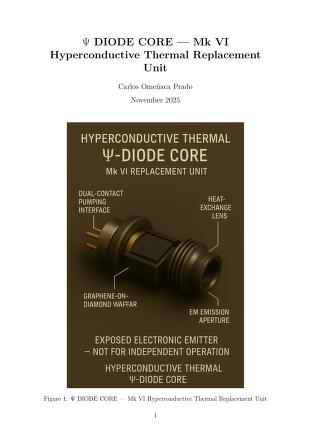
Ψ DIODE CORE -Mk VI Hyperconductive Thermal Replacement Unit

Graphene diode core for laser

Graphene DIODE CORE -Mk VI Hyperconductive Thermal Replacement Unit provides the full technical definition of the Ψ-Diode Core — Mk VI, the hyperconductive thermal emission element used inside Mk VI-class Ψ-LASER systems. It is an unencapsulated, high-power coherent emitter built around a graphene-on-diamond wafer, a sub-wavelength thermal-plasmonic cavity, a dual-contact pumping interface, and an EM-sealed optical aperture. The report details the device’s physical architecture, optical pathway, thermal-exchange geometry, electrical interface, mechanical tolerances, and functional role within complete Mk VI assemblies. The core is designed for laboratory integration, module replacement, and research-grade evaluation of Ψ-driven coherent emission. It is not a standalone device; it requires a Mk VI coherent-pressure driver, thermal-hyperconductive conditioning and proper EM shielding. The operational band spans the 18–65 THz region, delivering stable coherent output under extreme hyperconductive loading. Fabrication processes include micron-grade machining, wafer-flatness certification, optical burn-in and high-load contact testing. The Ψ-Diode Core defines the standard emission engine for all Mk VI coherent-pressure laser systems and establishes an interoperable architecture for next-generation Ψ-optical devices.

DOI: 10.5281/zenodo.17718450

Date: Nov 26, 2025

Author: Carlos Omeñaca Prado
ORCID: https://orcid.org/0009-0001-9750-5827

Resource type: Preprint
Publisher: Zenodo
License: CC0 Open Engineering Specification

Related links:

Seven New Classes of LASER Diodes Enabled by Graphene and the Psi-Field: A Quarkbase Cosmology Framework

Seven New Classes of LASER Diodes Enabled by Graphene

Seven Classes of LASER Diodes Enabled by Graphene and the Psi-Field introduces seven fundamentally new classes of laser diodes made possible by the interaction between graphene and the coherent pressure dynamics of the Ψ-field within the Quarkbase Cosmology framework. Instead of relying on electronic bandgaps, population inversion, or recombination physics, these devices operate through pressure-field resonance, curvature-dependent absorbance, coherent Ψ-phase dynamics, thermal hyperconductivity, plasmon–pressure hybridization, and anisotropic pressure redistribution. Each mechanism defines a distinct pathway for coherent electromagnetic emission in monolayer graphene. The document provides the physical foundation, device architectures, expected performance advantages, and experimental implications for all seven laser types. It positions graphene as a new universal photonic medium whose lasing capabilities arise from geometry, pressure coherence, and strain-engineered Ψ-field organization rather than electronic structure. The work is released under CC0/Public Domain, enabling unrestricted research, adaptation, and development.

DOI: 10.5281/zenodo.17718300

Date: Nov 26, 2025

Author: Carlos Omeñaca Prado
ORCID: https://orcid.org/0009-0001-9750-5827

Resource type: Preprint
Publisher: Zenodo
License: CC0 Open Engineering Specification

Related links:

Ψ-Cell – Industrializable Coherent-Pressure Energy Unit

Ψ-Cell: Industrializable Coherent-Pressure Energy Unit

Graphene Cell Industrializable Coherent-Pressure Energy Unit provides the complete, public-domain technical specification of the industrializable Ψ-Cell, a solid-state energy unit based on coherent vacuum-pressure dynamics. Its purpose is to enable any laboratory, company, or engineering group to fabricate, reproduce, and scale the Ψ-Cell using standard materials and manufacturing processes already available in 2025. The report describes: the full modular architecture (Modules A–F), the physical principles governing coherent-pressure interaction inside graphene interfaces, a fully explicit bill of materials (BOM), a step-by-step industrial manufacturing workflow, thermal and structural stability criteria, operational coherence modes (Ψ0, Ψ1, ΨR), reproducible testing and validation procedures, and a safety framework appropriate for a solid-state, chemistry-free device. The Ψ-Cell is designed to be scalable, array-compatible, and manufacturable using semiconductor clean-room equipment, advanced composites, and multilayer graphene assemblies. Released entirely under CC0, the document establishes a complete engineering baseline for producing a real, functional, and industrially manufacturable coherent-pressure energy unit

DOI: 10.5281/zenodo.17739980

Date: Nov 27, 2025

Author: Carlos Omeñaca Prado
ORCID: https://orcid.org/0009-0001-9750-5827

Resource type: Preprint
Publisher: Zenodo
License: CC0 Open Engineering Specification

Related links: