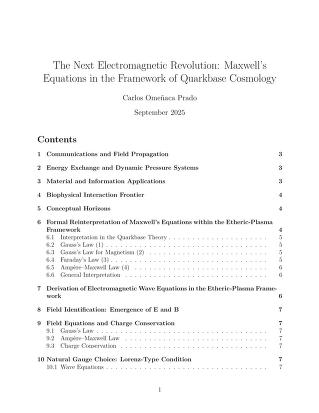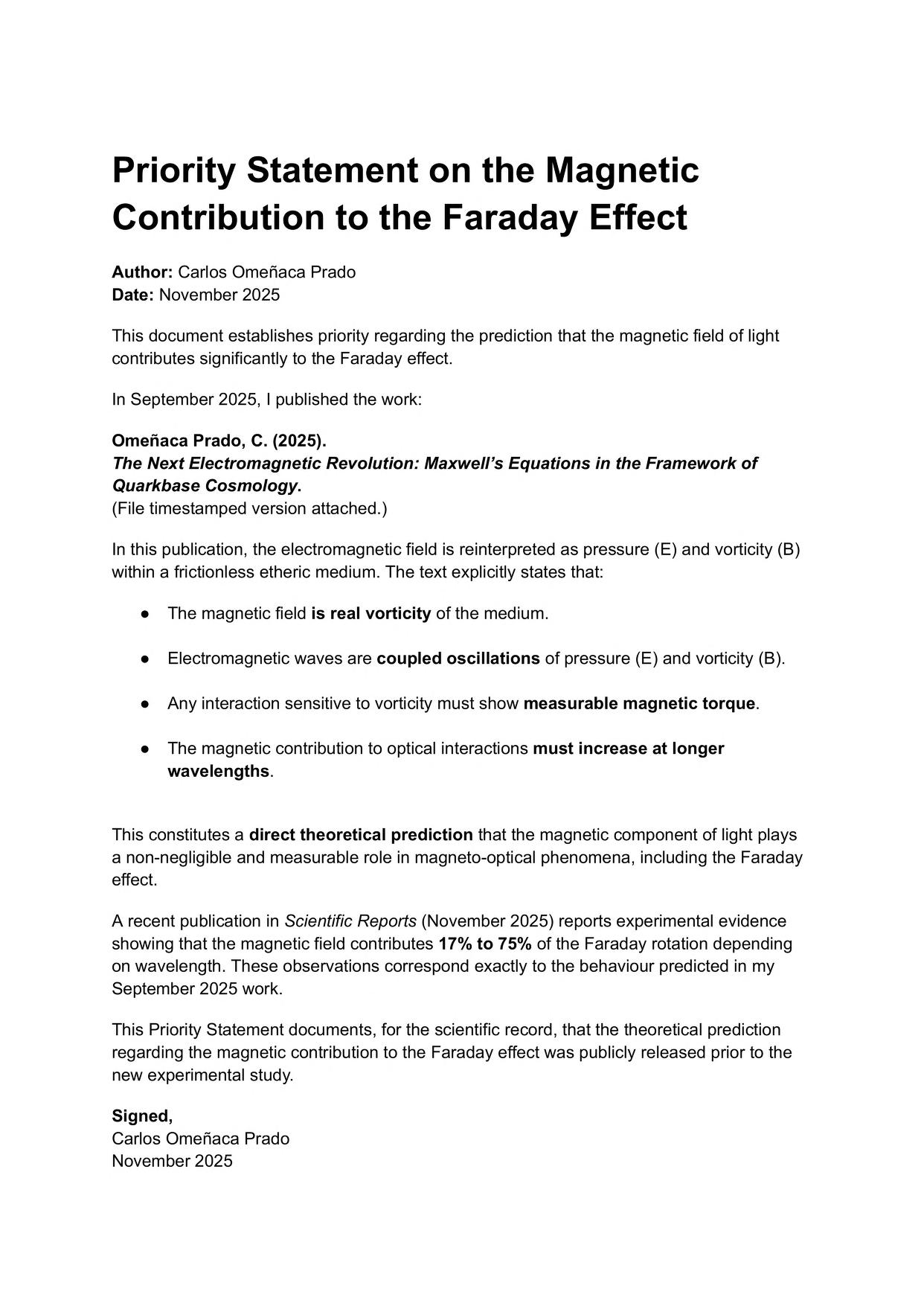
Priority Statement on the Magnetic Contribution to the Faraday Effect establishes priority for the theoretical prediction that the magnetic component of light contributes significantly to the Faraday effect. In September 2025, the work The Next Electromagnetic Revolution introduced a reinterpretation of electromagnetism in which the electric field represents pressure variations of a frictionless etheric medium and the magnetic field corresponds to its vorticity. Within this framework, any optical interaction sensitive to vorticity must display a measurable magnetic contribution, particularly at longer wavelengths. A Scientific Reports article published in November 2025 later reported experimental evidence showing that the magnetic field accounts for 17% to 75% of the observed Faraday rotation, precisely matching the predicted behaviour. This Priority Statement formally documents that the theoretical prediction was publicly released prior to the publication of the new experimental results.
Date: Nov 24, 2025
Author: Carlos Omeñaca Prado
ORCID: https://orcid.org/0009-0001-9750-5827
Resource type: Preprint
Publisher: Zenodo
License: CC BY-SA 4.0 International
Related links:
- https://zenodo.org/records/17718090
- https://archive.org/details/priority-statement
- https://www.academia.edu/145248158/Priority_Statement_on_the_Magnetic_Contribution_to_the_Faraday_Effect