X-Fenes: Longitudinal Vacuum Modes Confined by 2D Crystals

X-Fenes: Longitudinal Vacuum Modes Confined by 2D Crystals

X-Fenes: Longitudinal Vacuum Modes Confined by 2D Crystals introduces X-fenes, a unifying framework in which all two-dimensional crystals—graphene, silicene, phosphorene, h-BN, borophene and transition-metal dichalcogenides—are interpreted as confinement cavities for a longitudinal vacuum mode described by the Ψ-field. Within this picture, each monolayer defines a characteristic Ψ-resonance frequency, a BKT-like coherence scale, a screening length, and a lattice-topology factor that together determine its electrical, thermal and optical response. The study derives universal Ψ-scaling laws linking measurable quantities—joint electrical–thermal resonance frequency, resonance amplitude ratio, and strain–absorbance coefficient—to the underlying vacuum parameters of any X-fene. This allows two-dimensional materials to be treated as vacuum-wave circuit elements with well-defined Ψ-impedance and conversion channels. A complete and falsifiable experimental programme is proposed using THz spectroscopy, strain-tunable optics, and 2D heterostructure transport. If validated, X-fenes would provide the first laboratory-accessible platform for engineering longitudinal vacuum modes using existing 2D materials technology.

DOI: 10.5281/zenodo.17882937

Date: Dec 10, 2025

Author: Carlos Omeñaca Prado
ORCID: https://orcid.org/0009-0001-9750-5827

Resource type: Preprint
Publisher: Zenodo
License: CC BY-SA 4.0 International

Related links:

Superconductivity and Thermal Hyperconductivity in Graphene from Quarkbase Cosmology

The Quarkbase Cosmology Explanation of Superconductivity and Thermal Hyperconductivity in Graphene

Superconductivity and Thermal Hyperconductivity in Graphene from Quarkbase Cosmology develops a unified mechanism for superconductivity and thermal hyperconductivity in graphene within the framework of Quarkbase Cosmology. In this model, the vacuum is a frictionless etheric plasma described by a pressure field Ψ(x, t), and graphene acts as a two-dimensional resonant cavity that forces Ψ into coherent phase states. The paper derives an effective Ginzburg–Landau formulation for the collective Ψ-phase, predicts dissipationless electric currents without Cooper pairing, and shows how the same coherent dynamics account for graphene’s extreme thermal conductivity (>5000 W/m·K). A quantitative BKT analysis yields realistic Tc values (1–10 K), matching experimental data from pristine and twisted-bilayer graphene. The study provides multiple falsifiable predictions involving strain dependence, dielectric environment, resonant excitation, phase interferometry, and correlated variations of Tc and κ. It positions graphene as a direct macroscopic probe of the etheric pressure field and presents a coherent field-theoretic explanation for both its electrical and thermal anomalies

DOI: 10.5281/zenodo.17717264

Date: Nov 09, 2025

Author: Carlos Omeñaca Prado
ORCID: https://orcid.org/0009-0001-9750-5827

Resource type: Preprint
Publisher: Zenodo
License: CC BY-SA 4.0 International

Related links:

Curvature-Tunable Absorbance in Graphene: A Quarkbase-Cosmology Prediction

Curvature-Tunable Absorbance in Graphene

Curvature-Tunable Absorbance in Graphene: A Quarkbase-Cosmology Prediction presents a falsifiable prediction derived from Quarkbase Cosmology: the optical absorbance of monolayer graphene (A ≈ πα ≈ 2.3%) should vary linearly with curvature or biaxial strain. In this framework, light propagation is interpreted as the motion of longitudinal pressure waves in the etheric Ψ-field. Curvature modifies the local density of pressure channels guiding electromagnetic propagation, producing a small but measurable modulation of absorbance on the order of 10⁻³–10⁻² per % strain. The work outlines the theoretical derivation, proposes a simple experimental setup based on micro-ellipsometry and AFM curvature mapping, and identifies the result as a clean falsification test of Quarkbase Cosmology. A positive detection would challenge the assumed universality of graphene’s πα absorbance and provide direct evidence for etheric pressure dynamics as the substrate of electromagnetism.

DOI: 10.5281/zenodo.17717169

Date: Nov 09, 2025

Author: Carlos Omeñaca Prado
ORCID: https://orcid.org/0009-0001-9750-5827

Resource type: Preprint
Publisher: Zenodo
License: CC BY-SA 4.0 International

Related links:

Simultaneous Enhancement of Electrical and Thermal Conductivity in Graphene through Excitation of the Etheric Longitudinal Mode

Simultaneous Enhancement of Electrical and Thermal Conductivity in Graphene

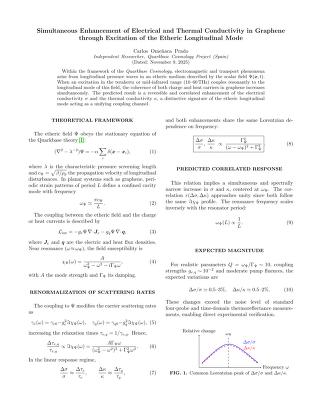
Simultaneous Enhancement of Electrical and Thermal Conductivity in Graphene through Excitation of the Etheric Longitudinal Mode presents a clear and experimentally testable prediction within the Quarkbase Cosmology framework: the resonant excitation of the etheric longitudinal mode in graphene (10–60 THz) produces a simultaneous and correlated enhancement of both electrical conductivity (σ) and thermal conductivity (κ). In this model, charge and heat transport are not governed solely by electron and phonon scattering, but by their coupling to the scalar pressure field Ψ(x,t) of the etheric plasma. When an external THz or mid-infrared excitation matches the natural resonance ωΨ of the confined longitudinal mode in graphene, the scattering rates decrease in parallel for electrical and thermal carriers, increasing the relaxation times τe and τq. Both σ and κ acquire the same Lorentzian resonance profile, centered at ωΨ, with the correlation between their enhancements approaching unity (r ≈ 1). Expected relative increases are: Δσ/σ ≈ 0.5–3% Δκ/κ ≈ 0.5–2% These values exceed the detection thresholds of standard four-probe electrical measurements and time-domain thermoreflectance, enabling a direct and feasible experimental verification. Observation of this paired response would constitute clear evidence that the etheric longitudinal mode acts as a unified transport channel—supporting the Quarkbase description of the vacuum as a frictionless pressure medium underlying electromagnetic and thermal phenomena.

DOI: 10.5281/zenodo.17717055

Date: Nov 25, 2025

Author: Carlos Omeñaca Prado
ORCID: https://orcid.org/0009-0001-9750-5827

Resource type: Preprint
Publisher: Zenodo
License: CC BY-SA 4.0 International

Related links:

Quantum Levitation – A Dual Interpretation from Standard Physics and Quarkbase Cosmology

Quantum Levitation

Quantum Levitation – A Dual Interpretation from Standard Physics and Quarkbase Cosmology provides the first dual interpretation of quantum levitation that unifies the standard superconducting framework (Meissner effect, flux pinning, London–Ginzburg–Landau formalism) with the pressure–vorticity dynamics of Quarkbase Cosmology. Magnetic fields are reinterpreted as vorticity tubes of the etheric Ψ-field, while superconductors appear as regions of high Ψ-phase coherence that geometrically reject or channel these structures. The study explains levitation, locking, and flux quantization as explicit reorganizations of the underlying pressure field, offering a physically transparent mechanism behind superconducting phenomena. It further connects these ideas with graphene behavior, the Ψ-Cell, the Ψ-Coil, and new possibilities for engineered Ψ-coherent materials and contactless guiding architectures. The document serves both as a rigorous reinterpretation of known superconducting effects and as a roadmap for future Quarkbase-based technologies.

DOI: 10.5281/zenodo.17718248

Date: Nov 26, 2025

Author: Carlos Omeñaca Prado
ORCID: https://orcid.org/0009-0001-9750-5827

Resource type: Preprint
Publisher: Zenodo
License: CC BY-SA 4.0 International

Related links: