Neutrino Oscillations As Internal Mode Interference In The Vacuum Pressure Field

Neutrino Oscillations as Internal Mode Interference in the Vacuum Pressure Field

Neutrino Oscillations As Internal Mode Interference In The Vacuum Pressure Field proposes an alternative ontological and dynamical interpretation within the framework of Quarkbase Cosmology, in which the neutrino is identified as the most elementary compactation (N = 1) of a continuous vacuum pressure field (Ψ-field). Neutrino oscillations are reinterpreted as interference between internal vibrational modes of a single fundamental entity propagating coherently through this medium, rather than as transitions between distinct massive particles. The framework reproduces the main observed phenomenology—including L/E scaling, the existence of two independent oscillation scales, long-range coherence, and matter effects—without introducing intrinsic neutrino masses, fundamental flavor labels, or a PMNS mixing matrix as ontological primitives. Standard parameters are recovered as effective descriptors of mode dispersion and interaction geometry. The manuscript explicitly states its scope as a preliminary ontological–dynamical framework rather than a completed field-theoretic formulation, and it outlines clear, falsifiable predictions that distinguish this interpretation from mass-based models, particularly at extreme energies, long baselines, and in nonstandard environments.

DOI: 10.5281/zenodo.17924967

Date: Dec 13, 2025

Author: Carlos Omeñaca Prado
ORCID: https://orcid.org/0009-0001-9750-5827

Resource type: Preprint
Publisher: Zenodo
License: CC BY-SA 4.0 International

Related links:

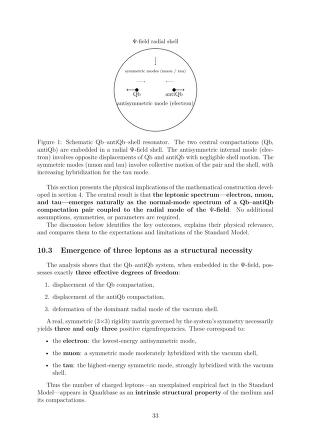
The Leptonic Spectrum of the Ψ-Field: A Three-Mode Resonator Explaining the Electron, Muon and Tau Hierarchy

The Leptonic Spectrum of the Psi-Field

The Leptonic Spectrum of the Ψ-Field develops a fully mechanical explanation of the leptonic sector within Quarkbase Cosmology. By modeling the electron, muon, and tau as the three normal modes of a neutral Qb–antiQb compactation pair coupled to the radial mode of a finite-range Ψ-field, the existence of exactly three charged leptons and their mass hierarchy emerges as a structural property of the medium. No Yukawa couplings or intrinsic mass parameters are required.
The framework also embeds neutrino oscillations, vacuum quantization, and potential mechanisms for matter–antimatter imbalance as natural consequences of the same resonator structure. This establishes a unified, medium-based interpretation of leptons as vibrational excitations of a continuous physical field, providing predictive coherence across particle physics, vacuum mechanics, and cosmology.

DOI: 10.5281/zenodo.17904239

Date: Dec 11, 2025

Author: Carlos Omeñaca Prado
ORCID: https://orcid.org/0009-0001-9750-5827

Resource type: Preprint
Publisher: Zenodo
License: CC BY-SA 4.0 International

Related links:

The Nuclear ‘mass’ defect as a Topological Property of Ether Confinement in Quarkbase Cosmology

The Nuclear mass defect as a Topological Property of Ether Confinement in Quarkbase Cosmology

The Nuclear mass defect as a Topological Property of Ether Confinement in Quarkbase Cosmology develops a geometric and topological reformulation of nuclear structure within the framework of Quarkbase Cosmology. In this model, nuclear properties do not arise from fundamental forces, intrinsic mass, or interaction mediators, but from the compact packing of quarkbases and from the stationary behavior of the ether’s pressure field Ψ. Two structural quantities are introduced: the total displaced volume V D and the gradient-carrying volume V ∇ , whose ratio defines the confinement fraction f conf. These magnitudes enable a unified description of nuclear phenomena-‘mass’ defect, binding energy, isotopic stability, magic numbers, and upper atomic limits-using only geometric and topological principles. In this framework, the classical ‘mass’ defect is fundamentally a volume defect: a deficit of accessible ether volume caused by the emergence of stationary-gradient confinement pockets. The cuarquic nuclear axiom, ∆P = β nucl V ∇ , identifies the nuclear ‘mass’ defect as the direct consequence of the three-dimensional topology of these confined ether domains. The stability criterion, dV ∇ dN q > v q , provides the necessary condition for a nucleus to admit a stationary Ψ-field solution. Together, these results eliminate the need for interaction-based descriptions of nuclear matter and establish a fully geometric account in which nuclear stability and binding arise from the topological structure of quarkbase packing and the stationary dynamics of the ether.

DOI: 10.5281/zenodo.17772168

Date: Nov 30, 2025

Author: Carlos Omeñaca Prado
ORCID: https://orcid.org/0009-0001-9750-5827

Resource type: Preprint
Publisher: Zenodo
License: CC BY-SA 4.0 International

Related links:

Color Confinement -The Unresolved Structural Anomaly of QCD

Color Confinement-The Unresolved Structural Anomaly of QCD

Color Confinement -The Unresolved Structural Anomaly of QCD proposes a new explanation for color confinement based on the mechanical stability of the etheric pressure field described in Quarkbase Cosmology. Instead of relying on numerical results from quantum chromodynamics, the analysis examines how multi-quark configurations load and deform the underlying vacuum medium. The key result is that only two-quark and three-quark systems remain mechanically stable, while any larger color configuration generates internal modes that destabilize the structure, preventing the formation of bound states. This provides a simple physical reason for the existence of mesons and baryons, and explains why no four-quark or higher-order pure-color states are observed in nature. The mechanism offers an analytic, medium-based perspective on confinement, complementing and extending standard QCD interpretations.

DOI: 10.5281/zenodo.17717961

Date: Nov 26, 2025

Author: Carlos Omeñaca Prado
ORCID: https://orcid.org/0009-0001-9750-5827

Resource type: Preprint
Publisher: Zenodo
License: CC BY-SA 4.0 International

Related links:

Nuclear Fission: Numerical Demonstrations of Equivalence Between the Standard Model and Quarkbase Cosmology

Nuclear Fission

Nuclear Fission: Numerical Demonstrations of Equivalence Between the Standard Model and Quarkbase Cosmology presents a direct numerical demonstration that nuclear-fission energetics—traditionally explained through mass defects and binding-energy differences—are exactly reproduced by the pressure-based formulation of Quarkbase Cosmology. Using only experimentally measured nuclear data, the analysis shows: the canonical ~200 MeV released per fission of ²³⁵U, the standard nuclear-energy density ~8×10¹³ J/kg, the liquid-drop surface-energy coefficient, and the hydrogen-level resonant energy scale are all obtained identically in both frameworks. The equivalence emerges from a single geometric identity: σ ΔA in Quarkbase (etheric surface tension × change in nuclear surface area) encodes exactly the same energy that the Standard Model attributes to Δm c². The paper computes all quantities explicitly: nuclear radii and areas, surface-area changes in asymmetric fission, effective σ consistent with the liquid-drop model, pressure–volume work in the quarkic medium, and the correspondence between E = mc², σΔA, and ΔP_bind·v_q. The key conclusion is not that the Standard Model is wrong, but that its numerical predictions can be reinterpreted as geometric pressure relaxations in a continuous etheric plasma. The numbers are identical. The interpretation is radically different. This result strengthens the consistency of Quarkbase Cosmology by showing that nuclear observables do not discriminate between the two theories—only the physical ontology does.

DOI: 10.5281/zenodo.17716663

Date: Dez 07, 2025

Author: Carlos Omeñaca Prado
ORCID: https://orcid.org/0009-0001-9750-5827

Resource type: Preprint
Publisher: Zenodo
License: CC BY-SA 4.0 International

Related links: