Why c Exists And Ether Said: “Let There Be Light and Relativity”
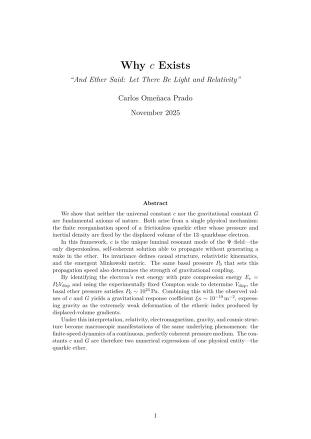
Why c exists

This work reconstructs the full mathematical structure of Einsteinian relativity from a physical medium: a frictionless scalar-pressure ether described by the field Ψ(x,t). Instead of postulating the invariance of c and Lorentz symmetry, the analysis shows that both emerge from the finite reorganisation speed of this medium. The Lorentz factor, relativistic kinematics, energy–momentum relations, and gravitational weak-field optics are recovered without invoking mass or geometric axioms. Einstein’s formalism remains valid, but its ontology is reversed: relativity becomes the macroscopic behaviour of a coherent pressure medium rather than a primitive geometric postulate.The theory derives nuclear and atomic constants (Rydberg value, hydrogen binding energy), predicts the next stable element of the periodic table (Z ≈ 155), and introduces an alternative fission mechanism based on resonance of the Ψ pressure field.
This preprint provides the foundational narrative of Quarkbase Cosmology: the emergence of structure, resonance, and coherence from compact quarkic configurations interacting with the etheric Ψ field.
Reconfirmation of the Relativistic Invariance of the Theory of Quarkbase (eng.): Detailed Mathematical Analysis

Reconfirmation_of_the_Relativistic_Invariance_of_the_Theory_of_Quarkbase

This work reconstructs the full mathematical structure of Einsteinian relativity from a physical medium: a frictionless scalar-pressure ether described by the field Ψ(x,t). Instead of postulating the invariance of c and Lorentz symmetry, the analysis shows that both emerge from the finite reorganisation speed of this medium. The Lorentz factor, relativistic kinematics, energy–momentum relations, and gravitational weak-field optics are recovered without invoking mass or geometric axioms. Einstein’s formalism remains valid, but its ontology is reversed: relativity becomes the macroscopic behaviour of a coherent pressure medium rather than a primitive geometric postulate.The theory derives nuclear and atomic constants (Rydberg value, hydrogen binding energy), predicts the next stable element of the periodic table (Z ≈ 155), and introduces an alternative fission mechanism based on resonance of the Ψ pressure field.
This preprint provides the foundational narrative of Quarkbase Cosmology: the emergence of structure, resonance, and coherence from compact quarkic configurations interacting with the etheric Ψ field.
The Michelson Morley Null Result As A Consequence Of A Frictionless Scalar Ether

The_Michelson_Morley_Null_Result_as_a_Consequence_of_a_Frictionless_Scalar_Ethe

This work reconstructs the full mathematical structure of Einsteinian relativity from a physical medium: a frictionless scalar-pressure ether described by the field Ψ(x,t). Instead of postulating the invariance of c and Lorentz symmetry, the analysis shows that both emerge from the finite reorganisation speed of this medium. The Lorentz factor, relativistic kinematics, energy–momentum relations, and gravitational weak-field optics are recovered without invoking mass or geometric axioms. Einstein’s formalism remains valid, but its ontology is reversed: relativity becomes the macroscopic behaviour of a coherent pressure medium rather than a primitive geometric postulate.The theory derives nuclear and atomic constants (Rydberg value, hydrogen binding energy), predicts the next stable element of the periodic table (Z ≈ 155), and introduces an alternative fission mechanism based on resonance of the Ψ pressure field.
This preprint provides the foundational narrative of Quarkbase Cosmology: the emergence of structure, resonance, and coherence from compact quarkic configurations interacting with the etheric Ψ field.
Genesis Quarkbase (english): The Functioning of the Universe

Genesis Quarkbase Thumbnail

This work presents a unified physical framework in which all fundamental interactions—gravitational, electromagnetic, strong, and weak, arise from a single principle: the global conservation of etheric volume in a frictionless plasmatic medium.
The theory derives nuclear and atomic constants (Rydberg value, hydrogen binding energy), predicts the next stable element of the periodic table (Z ≈ 155), and introduces an alternative fission mechanism based on resonance of the Ψ pressure field.
This preprint provides the foundational narrative of Quarkbase Cosmology: the emergence of structure, resonance, and coherence from compact quarkic configurations interacting with the etheric Ψ field.

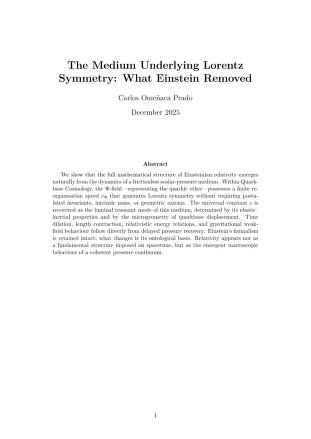
The Medium Underlying Lorentz Symmetry: What Einstein Removed

The Medium Underlying Lorentz Symmetry

This work reconstructs the full mathematical structure of Einsteinian relativity from a physical medium: a frictionless scalar-pressure ether described by the field Ψ(x,t). Instead of postulating the invariance of c and Lorentz symmetry, the analysis shows that both emerge from the finite reorganisation speed of this medium. The Lorentz factor, relativistic kinematics, energy–momentum relations, and gravitational weak-field optics are recovered without invoking mass or geometric axioms. Einstein’s formalism remains valid, but its ontology is reversed: relativity becomes the macroscopic behaviour of a coherent pressure medium rather than a primitive geometric postulate.The theory derives nuclear and atomic constants (Rydberg value, hydrogen binding energy), predicts the next stable element of the periodic table (Z ≈ 155), and introduces an alternative fission mechanism based on resonance of the Ψ pressure field.
This preprint provides the foundational narrative of Quarkbase Cosmology: the emergence of structure, resonance, and coherence from compact quarkic configurations interacting with the etheric Ψ field.