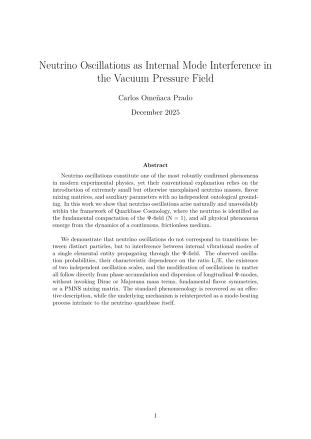
Neutrino Oscillations As Internal Mode Interference In The Vacuum Pressure Field

Neutrino Oscillations as Internal Mode Interference in the Vacuum Pressure Field

Neutrino Oscillations As Internal Mode Interference In The Vacuum Pressure Field proposes an alternative ontological and dynamical interpretation within the framework of Quarkbase Cosmology, in which the neutrino is identified as the most elementary compactation (N = 1) of a continuous vacuum pressure field (Ψ-field). Neutrino oscillations are reinterpreted as interference between internal vibrational modes of a single fundamental entity propagating coherently through this medium, rather than as transitions between distinct massive particles. The framework reproduces the main observed phenomenology—including L/E scaling, the existence of two independent oscillation scales, long-range coherence, and matter effects—without introducing intrinsic neutrino masses, fundamental flavor labels, or a PMNS mixing matrix as ontological primitives. Standard parameters are recovered as effective descriptors of mode dispersion and interaction geometry. The manuscript explicitly states its scope as a preliminary ontological–dynamical framework rather than a completed field-theoretic formulation, and it outlines clear, falsifiable predictions that distinguish this interpretation from mass-based models, particularly at extreme energies, long baselines, and in nonstandard environments.

DOI: 10.5281/zenodo.17924967

Date: Dec 13, 2025

Author: Carlos Omeñaca Prado
ORCID: https://orcid.org/0009-0001-9750-5827

Resource type: Preprint
Publisher: Zenodo
License: CC BY-SA 4.0 International

Related links:

Cosmological Redshift Without Expansion: The Quarkbase Cosmology Explanation

Cosmological Redshift Without Expansion

Cosmological Redshift Without Expansion presents a physical reinterpretation of cosmological redshift within the framework of Quarkbase Cosmology. In contrast to the standard geometric interpretation based on expanding space, the redshift is explained as a consequence of the evolution of a real physical medium, the Ψ-field, which underlies light propagation and local measurement processes.

Light is described as a non-dissipative luminal resonant mode of this medium, while frequency is defined operationally through its coupling to local material resonators. The redshift is shown to arise from differences between the state of the Ψ-field at emission and observation, summarized by the relation:

1 + z = n(tobs) / n(temit)

This approach reproduces the observed redshift–distance relation without invoking expanding space, accelerated cosmic expansion, or dark energy, and reframes cosmological redshift as a direct probe of the physical state and temporal evolution of the universe’s underlying medium.

DOI: 10.5281/zenodo.17917488

Date: Dec 12, 2025

Author: Carlos Omeñaca Prado
ORCID: https://orcid.org/0009-0001-9750-5827

Resource type: Preprint
Publisher: Zenodo
License: CC BY-SA 4.0 International

Related links:

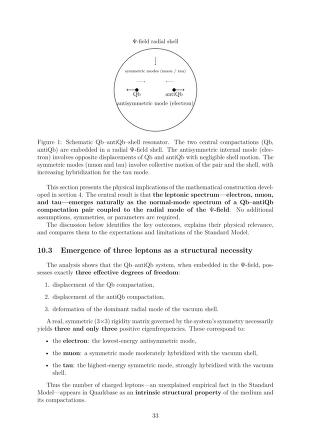
The Leptonic Spectrum of the Ψ-Field: A Three-Mode Resonator Explaining the Electron, Muon and Tau Hierarchy

The Leptonic Spectrum of the Psi-Field

The Leptonic Spectrum of the Ψ-Field develops a fully mechanical explanation of the leptonic sector within Quarkbase Cosmology. By modeling the electron, muon, and tau as the three normal modes of a neutral Qb–antiQb compactation pair coupled to the radial mode of a finite-range Ψ-field, the existence of exactly three charged leptons and their mass hierarchy emerges as a structural property of the medium. No Yukawa couplings or intrinsic mass parameters are required.
The framework also embeds neutrino oscillations, vacuum quantization, and potential mechanisms for matter–antimatter imbalance as natural consequences of the same resonator structure. This establishes a unified, medium-based interpretation of leptons as vibrational excitations of a continuous physical field, providing predictive coherence across particle physics, vacuum mechanics, and cosmology.

DOI: 10.5281/zenodo.17904239

Date: Dec 11, 2025

Author: Carlos Omeñaca Prado
ORCID: https://orcid.org/0009-0001-9750-5827

Resource type: Preprint
Publisher: Zenodo
License: CC BY-SA 4.0 International

Related links:

X-Fenes: Longitudinal Vacuum Modes Confined by 2D Crystals

X-Fenes: Longitudinal Vacuum Modes Confined by 2D Crystals

X-Fenes: Longitudinal Vacuum Modes Confined by 2D Crystals introduces X-fenes, a unifying framework in which all two-dimensional crystals—graphene, silicene, phosphorene, h-BN, borophene and transition-metal dichalcogenides—are interpreted as confinement cavities for a longitudinal vacuum mode described by the Ψ-field. Within this picture, each monolayer defines a characteristic Ψ-resonance frequency, a BKT-like coherence scale, a screening length, and a lattice-topology factor that together determine its electrical, thermal and optical response. The study derives universal Ψ-scaling laws linking measurable quantities—joint electrical–thermal resonance frequency, resonance amplitude ratio, and strain–absorbance coefficient—to the underlying vacuum parameters of any X-fene. This allows two-dimensional materials to be treated as vacuum-wave circuit elements with well-defined Ψ-impedance and conversion channels. A complete and falsifiable experimental programme is proposed using THz spectroscopy, strain-tunable optics, and 2D heterostructure transport. If validated, X-fenes would provide the first laboratory-accessible platform for engineering longitudinal vacuum modes using existing 2D materials technology.

DOI: 10.5281/zenodo.17882937

Date: Dec 10, 2025

Author: Carlos Omeñaca Prado
ORCID: https://orcid.org/0009-0001-9750-5827

Resource type: Preprint
Publisher: Zenodo
License: CC BY-SA 4.0 International

Related links:

Biomedical Implications of Quarkbase Cosmology: A Unified Framework for Ψ-Field Biophysics and Future Therapeutics

Biomedical Implications of Quarkbase Cosmology

Biomedical Implications of Quarkbase Cosmology extends the Quarkbase Cosmology framework into the domain of biophysics and medicine. It develops the theoretical basis for Ψ–matter coupling in biological systems, formulates the mathematical and energetic thresholds for observable effects, and outlines the five universal mechanisms through which Ψ-gradients, fluctuations, and resonances can influence molecular, cellular, and tissue dynamics. The document presents a complete experimental verification pipeline—from optomechanical and quantum sensors to in vitro, ex vivo, and preclinical assays—together with case studies, technological requirements, and long-term biomedical applications. These include Ψ-based imaging beyond electromagnetic methods, selective therapeutic activation, Ψ-responsive biomaterials, neuromodulation, and new computational modes in living systems. The work provides a unified, testable framework for the emergence of Ψ-biomedicine as a scientific field

DOI: 10.5281/zenodo.17875079

Date: Dec 10, 2025

Author: Carlos Omeñaca Prado
ORCID: https://orcid.org/0009-0001-9750-5827

Resource type: Preprint
Publisher: Zenodo
License: CC BY-SA 4.0 International

Related links:

Gravitation Without Mass – A Geometric Pressure Interpretation of Curvature

Gravitation Without Mass

Gravitation Without Mass – A Geometric Pressure Interpretation of Curvature raises the question: Can mass be defined if only one object exists in the universe? 
This work argues that it cannot: mass is a relational quantity with no physical meaning in a one-object universe. Using the ADM 3+1 formalism, gravitational acceleration is expressed as the orthogonal projection of the curvature gradient—a structure formally equivalent to a pressure gradient.

This leads to a reinterpretation of gravity as geometric pressure acting on the compact volume displaced by an object, rather than a force sourced by mass. The framework leaves Einstein’s equations untouched while replacing the classical mass→curvature linkage with a volume→pressure mechanism that is ontologically consistent, operationally definable, and naturally compatible with quantum descriptions.

The result clarifies the conceptual foundations of General Relativity, dissolves the classical–quantum discontinuity without introducing gravitons, and avoids unwarranted unification claims by explicitly restricting the interpretation to gravity alone.

DOI: 10.5281/zenodo.17873312

Date: Dec 10, 2025

Author: Carlos Omeñaca Prado
ORCID: https://orcid.org/0009-0001-9750-5827

Resource type: Preprint
Publisher: Zenodo
License: CC BY-SA 4.0 International

Related links:

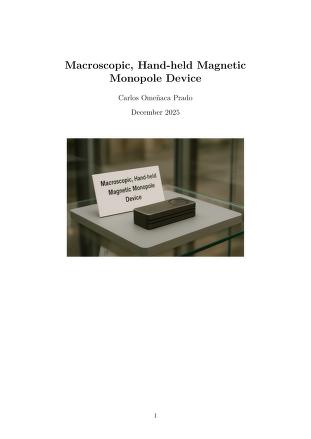
Macroscopic, Hand-held Magnetic Monopole Device

Macroscopic, Hand-held Magnetic Monopole Device

Macroscopic Magnetic Monopole Device presents the first complete engineering blueprint for a physically realizable magnetic monopole within the framework of Quarkbase Cosmology. Building on the interpretation of the magnetic field as etheric vorticity in the Ψ-field, the work demonstrates how displaced Ψ-vortices in twisted bilayer graphene can be phase-aligned and flux-summed to yield a macroscopic, unipolar magnetic output. The device uses thousands of engineered Ψ-modules, each hosting a stabilized vortex with a confined return string, integrated through a ferromagnetic micro-yoke network. A multi-scale collector plate, central flux-chimney, and a fully internal return-manifold channel all compensate flux internally, ensuring that only one external magnetic pole is detectable—while still satisfying ∇·B = 0 at the global level. The full document includes: • detailed physical principles and Quarkbase electrodynamics, • vortex engineering in TBG, • anisotropic stiffness landscapes and strain-pinned vortex cores, • 3D CAD-ready mechanical architecture, • cryogenic system, THz longitudinal-mode pump, phase-coherence strategy, • operational modes, safety constraints, calibration and failure-mode analysis. The result is a 35 mm × 18 mm hand-held solid device that behaves externally as a magnetic monopole and inaugurates the field of Macroscopic Etheric-Topology Devices

DOI: 10.5281/zenodo.17825885

Date: Dec 05, 2025

Author: Carlos Omeñaca Prado
ORCID: https://orcid.org/0009-0001-9750-5827

Resource type: Preprint
Publisher: Zenodo
License: CC0 Open Engineering Specification

Related links:

Effective Graphene Monopole and Its Application to Water Transport

Effective Graphene Monopole

Effective Graphene Monopole and Its Application to Water Transport introduces a fully specified effective graphene-based monopole built on an asymmetric ferromagnetic toroidal core with a curved graphene patch. The device produces a stable pseudo-monopolar field through controlled symmetry breaking, enabling measurable front/back flux imbalance and a near-1/r² radial decay in the frontal hemisphere. A practical application is developed: a water-lifting module capable of moving water without mechanical pumps or moving parts, using only a few watts of electrical power. All geometries, field protocols, and engineering details are released under CC0 to enable immediate humanitarian deployment and open replication.

DOI: 10.5281/zenodo.17823026

Date: Dec 05, 2025

Author: Carlos Omeñaca Prado
ORCID: https://orcid.org/0009-0001-9750-5827

Resource type: Preprint
Publisher: Zenodo
License: CC0 Open Engineering Specification

Related links:

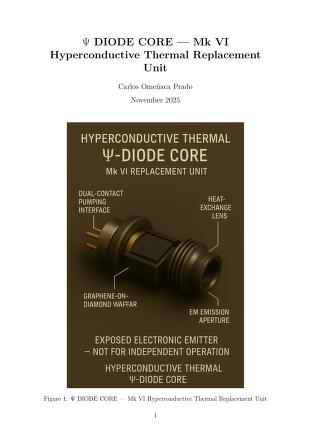
Ψ DIODE CORE -Mk VI Hyperconductive Thermal Replacement Unit

Graphene diode core for laser

Graphene DIODE CORE -Mk VI Hyperconductive Thermal Replacement Unit provides the full technical definition of the Ψ-Diode Core — Mk VI, the hyperconductive thermal emission element used inside Mk VI-class Ψ-LASER systems. It is an unencapsulated, high-power coherent emitter built around a graphene-on-diamond wafer, a sub-wavelength thermal-plasmonic cavity, a dual-contact pumping interface, and an EM-sealed optical aperture. The report details the device’s physical architecture, optical pathway, thermal-exchange geometry, electrical interface, mechanical tolerances, and functional role within complete Mk VI assemblies. The core is designed for laboratory integration, module replacement, and research-grade evaluation of Ψ-driven coherent emission. It is not a standalone device; it requires a Mk VI coherent-pressure driver, thermal-hyperconductive conditioning and proper EM shielding. The operational band spans the 18–65 THz region, delivering stable coherent output under extreme hyperconductive loading. Fabrication processes include micron-grade machining, wafer-flatness certification, optical burn-in and high-load contact testing. The Ψ-Diode Core defines the standard emission engine for all Mk VI coherent-pressure laser systems and establishes an interoperable architecture for next-generation Ψ-optical devices.

DOI: 10.5281/zenodo.17718450

Date: Nov 26, 2025

Author: Carlos Omeñaca Prado
ORCID: https://orcid.org/0009-0001-9750-5827

Resource type: Preprint
Publisher: Zenodo
License: CC0 Open Engineering Specification

Related links:

Seven New Classes of LASER Diodes Enabled by Graphene and the Psi-Field: A Quarkbase Cosmology Framework

Seven New Classes of LASER Diodes Enabled by Graphene

Seven Classes of LASER Diodes Enabled by Graphene and the Psi-Field introduces seven fundamentally new classes of laser diodes made possible by the interaction between graphene and the coherent pressure dynamics of the Ψ-field within the Quarkbase Cosmology framework. Instead of relying on electronic bandgaps, population inversion, or recombination physics, these devices operate through pressure-field resonance, curvature-dependent absorbance, coherent Ψ-phase dynamics, thermal hyperconductivity, plasmon–pressure hybridization, and anisotropic pressure redistribution. Each mechanism defines a distinct pathway for coherent electromagnetic emission in monolayer graphene. The document provides the physical foundation, device architectures, expected performance advantages, and experimental implications for all seven laser types. It positions graphene as a new universal photonic medium whose lasing capabilities arise from geometry, pressure coherence, and strain-engineered Ψ-field organization rather than electronic structure. The work is released under CC0/Public Domain, enabling unrestricted research, adaptation, and development.

DOI: 10.5281/zenodo.17718300

Date: Nov 26, 2025

Author: Carlos Omeñaca Prado
ORCID: https://orcid.org/0009-0001-9750-5827

Resource type: Preprint
Publisher: Zenodo
License: CC0 Open Engineering Specification

Related links: