Ψ-Cell – Industrializable Coherent-Pressure Energy Unit

Ψ-Cell: Industrializable Coherent-Pressure Energy Unit

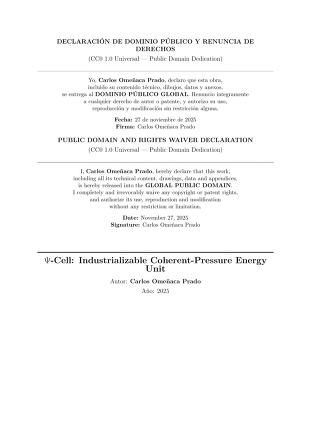
Graphene Cell Industrializable Coherent-Pressure Energy Unit provides the complete, public-domain technical specification of the industrializable Ψ-Cell, a solid-state energy unit based on coherent vacuum-pressure dynamics. Its purpose is to enable any laboratory, company, or engineering group to fabricate, reproduce, and scale the Ψ-Cell using standard materials and manufacturing processes already available in 2025. The report describes: the full modular architecture (Modules A–F), the physical principles governing coherent-pressure interaction inside graphene interfaces, a fully explicit bill of materials (BOM), a step-by-step industrial manufacturing workflow, thermal and structural stability criteria, operational coherence modes (Ψ0, Ψ1, ΨR), reproducible testing and validation procedures, and a safety framework appropriate for a solid-state, chemistry-free device. The Ψ-Cell is designed to be scalable, array-compatible, and manufacturable using semiconductor clean-room equipment, advanced composites, and multilayer graphene assemblies. Released entirely under CC0, the document establishes a complete engineering baseline for producing a real, functional, and industrially manufacturable coherent-pressure energy unit

DOI: 10.5281/zenodo.17739980

Date: Nov 27, 2025

Author: Carlos Omeñaca Prado
ORCID: https://orcid.org/0009-0001-9750-5827

Resource type: Preprint
Publisher: Zenodo
License: CC0 Open Engineering Specification

Related links:

Superconductivity and Thermal Hyperconductivity in Graphene from Quarkbase Cosmology

The Quarkbase Cosmology Explanation of Superconductivity and Thermal Hyperconductivity in Graphene

Superconductivity and Thermal Hyperconductivity in Graphene from Quarkbase Cosmology develops a unified mechanism for superconductivity and thermal hyperconductivity in graphene within the framework of Quarkbase Cosmology. In this model, the vacuum is a frictionless etheric plasma described by a pressure field Ψ(x, t), and graphene acts as a two-dimensional resonant cavity that forces Ψ into coherent phase states. The paper derives an effective Ginzburg–Landau formulation for the collective Ψ-phase, predicts dissipationless electric currents without Cooper pairing, and shows how the same coherent dynamics account for graphene’s extreme thermal conductivity (>5000 W/m·K). A quantitative BKT analysis yields realistic Tc values (1–10 K), matching experimental data from pristine and twisted-bilayer graphene. The study provides multiple falsifiable predictions involving strain dependence, dielectric environment, resonant excitation, phase interferometry, and correlated variations of Tc and κ. It positions graphene as a direct macroscopic probe of the etheric pressure field and presents a coherent field-theoretic explanation for both its electrical and thermal anomalies

DOI: 10.5281/zenodo.17717264

Date: Nov 09, 2025

Author: Carlos Omeñaca Prado
ORCID: https://orcid.org/0009-0001-9750-5827

Resource type: Preprint
Publisher: Zenodo
License: CC BY-SA 4.0 International

Related links:

Curvature-Tunable Absorbance in Graphene: A Quarkbase-Cosmology Prediction

Curvature-Tunable Absorbance in Graphene

Curvature-Tunable Absorbance in Graphene: A Quarkbase-Cosmology Prediction presents a falsifiable prediction derived from Quarkbase Cosmology: the optical absorbance of monolayer graphene (A ≈ πα ≈ 2.3%) should vary linearly with curvature or biaxial strain. In this framework, light propagation is interpreted as the motion of longitudinal pressure waves in the etheric Ψ-field. Curvature modifies the local density of pressure channels guiding electromagnetic propagation, producing a small but measurable modulation of absorbance on the order of 10⁻³–10⁻² per % strain. The work outlines the theoretical derivation, proposes a simple experimental setup based on micro-ellipsometry and AFM curvature mapping, and identifies the result as a clean falsification test of Quarkbase Cosmology. A positive detection would challenge the assumed universality of graphene’s πα absorbance and provide direct evidence for etheric pressure dynamics as the substrate of electromagnetism.

DOI: 10.5281/zenodo.17717169

Date: Nov 09, 2025

Author: Carlos Omeñaca Prado
ORCID: https://orcid.org/0009-0001-9750-5827

Resource type: Preprint
Publisher: Zenodo
License: CC BY-SA 4.0 International

Related links:

Simultaneous Enhancement of Electrical and Thermal Conductivity in Graphene through Excitation of the Etheric Longitudinal Mode

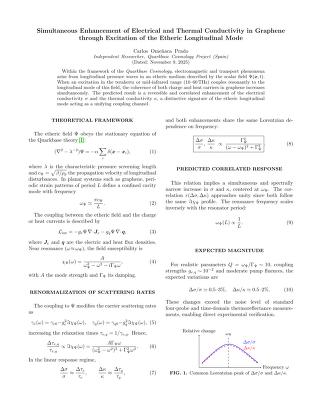
Simultaneous Enhancement of Electrical and Thermal Conductivity in Graphene

Simultaneous Enhancement of Electrical and Thermal Conductivity in Graphene through Excitation of the Etheric Longitudinal Mode presents a clear and experimentally testable prediction within the Quarkbase Cosmology framework: the resonant excitation of the etheric longitudinal mode in graphene (10–60 THz) produces a simultaneous and correlated enhancement of both electrical conductivity (σ) and thermal conductivity (κ). In this model, charge and heat transport are not governed solely by electron and phonon scattering, but by their coupling to the scalar pressure field Ψ(x,t) of the etheric plasma. When an external THz or mid-infrared excitation matches the natural resonance ωΨ of the confined longitudinal mode in graphene, the scattering rates decrease in parallel for electrical and thermal carriers, increasing the relaxation times τe and τq. Both σ and κ acquire the same Lorentzian resonance profile, centered at ωΨ, with the correlation between their enhancements approaching unity (r ≈ 1). Expected relative increases are: Δσ/σ ≈ 0.5–3% Δκ/κ ≈ 0.5–2% These values exceed the detection thresholds of standard four-probe electrical measurements and time-domain thermoreflectance, enabling a direct and feasible experimental verification. Observation of this paired response would constitute clear evidence that the etheric longitudinal mode acts as a unified transport channel—supporting the Quarkbase description of the vacuum as a frictionless pressure medium underlying electromagnetic and thermal phenomena.

DOI: 10.5281/zenodo.17717055

Date: Nov 25, 2025

Author: Carlos Omeñaca Prado
ORCID: https://orcid.org/0009-0001-9750-5827

Resource type: Preprint
Publisher: Zenodo
License: CC BY-SA 4.0 International

Related links:

Quantum Levitation – A Dual Interpretation from Standard Physics and Quarkbase Cosmology

Quantum Levitation

Quantum Levitation – A Dual Interpretation from Standard Physics and Quarkbase Cosmology provides the first dual interpretation of quantum levitation that unifies the standard superconducting framework (Meissner effect, flux pinning, London–Ginzburg–Landau formalism) with the pressure–vorticity dynamics of Quarkbase Cosmology. Magnetic fields are reinterpreted as vorticity tubes of the etheric Ψ-field, while superconductors appear as regions of high Ψ-phase coherence that geometrically reject or channel these structures. The study explains levitation, locking, and flux quantization as explicit reorganizations of the underlying pressure field, offering a physically transparent mechanism behind superconducting phenomena. It further connects these ideas with graphene behavior, the Ψ-Cell, the Ψ-Coil, and new possibilities for engineered Ψ-coherent materials and contactless guiding architectures. The document serves both as a rigorous reinterpretation of known superconducting effects and as a roadmap for future Quarkbase-based technologies.

DOI: 10.5281/zenodo.17718248

Date: Nov 26, 2025

Author: Carlos Omeñaca Prado
ORCID: https://orcid.org/0009-0001-9750-5827

Resource type: Preprint
Publisher: Zenodo
License: CC BY-SA 4.0 International

Related links:

Birth and Life of a Black Hole in Quarkbase Cosmology

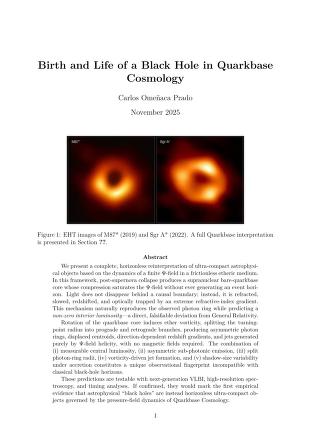
Birth and Life of a Black Hole in Quarkbase Cosmology

Birth and Life of a Black Hole in Quarkbase Cosmology presents a complete, horizonless reinterpretation of astrophysical black holes within the Quarkbase Cosmology framework. Instead of forming an event horizon or singularity, post-supernova collapse produces a supranuclear quarkbase core whose extreme compression saturates the Ψ-field. The resulting ultra-compact object traps and bends light through a steep refractive-index gradient, not through spacetime curvature. The theory reproduces all major observational features attributed to black holes—photon rings, brightness asymmetry, jet formation, and shadow morphology—without invoking horizons. Light is optically trapped, strongly redshifted, and partially re-emitted, generating a faint but non-zero interior luminosity. Rotation of the quarkbase core induces ether vorticity, splitting the turning-point radius into prograde and retrograde branches, producing displaced ring centroids, asymmetric brightness distributions, and vorticity-driven jets without magnetic fields. The model yields a suite of falsifiable predictions: – non-zero interior luminosity (10⁻⁵–10⁻³ of ring brightness), – split photon-ring radii, – ring-centroid displacement independent of Kerr geometry, – jet formation without magnetic fields, – shadow-size variability under accretion, – and sub-photonic emission leaking from the trapping region. These signatures distinguish horizonless quarkbase objects from classical GR black holes and can be tested with next-generation VLBI, high-resolution spectroscopy, and timing analyses.

DOI: 10.5281/zenodo.17750181

Date: Nov 28, 2025

Author: Carlos Omeñaca Prado
ORCID: https://orcid.org/0009-0001-9750-5827

Resource type: Preprint
Publisher: Zenodo
License: CC BY-SA 4.0 International

Related links:

The Fatal Paradox of Classical Physics in Black Holes

The Fatal Paradox of Classical Physics in Black Holes

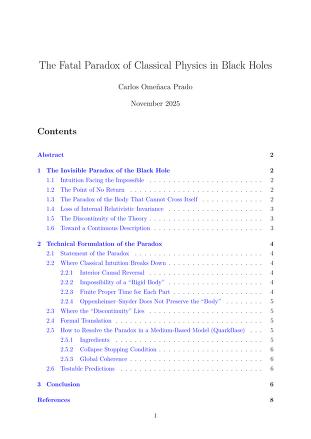
The Fatal Paradox of Classical Physics in Black Holes formulates one of the deepest and least acknowledged contradictions in classical black-hole physics: the “singularity of the parts.” General relativity predicts that an event horizon forms at the Schwarzschild radius, and that every material element inside must reach the singularity in finite proper time. But once the horizon exists, no extended body can remain coherent across the interior region. Each “part” of the collapsing object follows its own causal destiny toward r = 0, destroying the notion of a continuous body long before reaching the central singularity. This produces an ontological discontinuity inside classical GR: the theory preserves the metric mathematically, but destroys the physical category of “matter” needed to interpret that metric. The interior of a black hole cannot contain an extended object, cannot preserve simultaneity of its parts, and cannot maintain relativistic invariance. The collapse becomes undefined as a physical process, even though the equations remain formally valid. The work shows that GR offers no continuous macroscopic state between the event horizon and r = 0—only a collection of worldlines that terminate independently. The standard narrative “the star contracts until it becomes a point” is physically impossible, because the star ceases to exist as a body before the singularity is reached. The paper then explains how this paradox is resolved in Quarkbase Cosmology: by replacing the empty interior with a continuous plasmatic ether medium (Ψ-field) that preserves global coherence, halts collapse at a finite radius, and removes the singularity entirely. This reinterpretation restores physical continuity and turns the black-hole interior into a well-defined state of confined etheric pressure.

DOI: 10.5281/zenodo.17716912

Date: Nov 18, 2025

Author: Carlos Omeñaca Prado
ORCID: https://orcid.org/0009-0001-9750-5827

Resource type: Preprint
Publisher: Zenodo
License: CC BY-SA 4.0 International

Related links:

3I ATLAS explained

3I ATLAS explained

3I ATLAS explained reinterprets quasars within the Quarkbase Cosmology framework as large-scale resonators of the etheric plasma field Ψ, rather than mere products of gravitational accretion. In this model, the extreme luminosity of quasars arises from quark–gluon reconfiguration occurring in the inner regions of active galactic nuclei, where matter approaching a supermassive black hole reaches densities close to the quark–gluon critical threshold. The theory introduces a quarkbase correction factor ΦQ that amplifies the standard accretion luminosity when the local excitation density ρq approaches the critical density ρcrit, providing a natural explanation for the exceptional brightness of quasars without invoking exotic efficiencies or fine-tuned mechanisms. Quasars are therefore interpreted as cosmic converters: macroscopic windows where microscopic quark dynamics interact with cosmological-scale structures. Their emission becomes a direct observational signature of phase-transition physics usually accessible only in early-universe conditions. The model yields clear implications for cosmology, suggesting that quasars can function as testbeds for quark–gluon transitions, etheric-plasma behavior, and energy-conversion processes predicted by Quarkbase Cosmology.

DOI: 10.5281/zenodo.17717913

Date: Nov 16, 2025

Author: Carlos Omeñaca Prado
ORCID: https://orcid.org/0009-0001-9750-5827

Resource type: Preprint
Publisher: Zenodo
License: CC BY-SA 4.0 International

Related links:

Relativity as a Pressure Phenomenon in the Quarkic Ether

Relativity as a Pressure Phenomenon in the Quarkic Ether

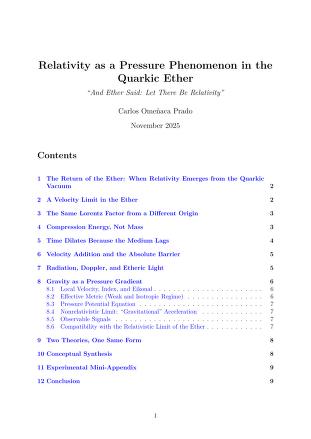
Relativity as a Pressure Phenomenon in the Quarkic Ether reformulates Relativity as a macroscopic pressure phenomenon of the quarkic ether. Instead of interpreting time dilation, length contraction, and inertial growth as geometric postulates of spacetime, this work shows that they arise naturally from the delayed volumetric recovery of a perfect-pressure medium. A moving quarkbase generates frontal compression and a trailing wake whose finite propagation speed cΨ reproduces the full Lorentz factor, the relativistic energy relations, and the velocity-addition law. Gravity appears as a gradient of the etheric index nΨ(x), yielding an effective metric formally identical to general relativity but rooted in physical pressure dynamics. All classical relativistic effects—including Doppler shift, aberration, Shapiro delay, lensing, and cosmological redshift—emerge from the hydrodynamic behaviour of a frictionless continuum. Thus, relativity does not replace the ether: it reveals its macroscopic shadow

DOI: 10.5281/zenodo.17717027

Date: Nov 18, 2025

Author: Carlos Omeñaca Prado
ORCID: https://orcid.org/0009-0001-9750-5827

Resource type: Preprint
Publisher: Zenodo
License: CC BY-SA 4.0 International

Related links:

Quasars in the Framework of Quarkbase Cosmology

Quasars in the Framework of Quarkbase Cosmology

Quasars in the Framework of Quarkbase Cosmology reinterprets quasars within the Quarkbase Cosmology framework as large-scale resonators of the etheric plasma field Ψ, rather than mere products of gravitational accretion. In this model, the extreme luminosity of quasars arises from quark–gluon reconfiguration occurring in the inner regions of active galactic nuclei, where matter approaching a supermassive black hole reaches densities close to the quark–gluon critical threshold. The theory introduces a quarkbase correction factor ΦQ that amplifies the standard accretion luminosity when the local excitation density ρq approaches the critical density ρcrit, providing a natural explanation for the exceptional brightness of quasars without invoking exotic efficiencies or fine-tuned mechanisms. Quasars are therefore interpreted as cosmic converters: macroscopic windows where microscopic quark dynamics interact with cosmological-scale structures. Their emission becomes a direct observational signature of phase-transition physics usually accessible only in early-universe conditions. The model yields clear implications for cosmology, suggesting that quasars can function as testbeds for quark–gluon transitions, etheric-plasma behavior, and energy-conversion processes predicted by Quarkbase Cosmology.

DOI: 10.5281/zenodo.17717220

Date: Sept 09, 2025

Author: Carlos Omeñaca Prado
ORCID: https://orcid.org/0009-0001-9750-5827

Resource type: Preprint
Publisher: Zenodo
License: CC BY-SA 4.0 International

Related links: