General Cosmology of Quarkbase (Neutrino)

General Cosmology of Quarkbase (Neutrino)

General Cosmology of Quarkbase (Neutrino) presents General Cosmology of Quarkbase (Neutrino), an expanded and refined development of the foundational framework introduced in Genesis Quarkbase: The Functioning of the Universe. The model reformulates fundamental physics through a single ontological postulate: all physical phenomena arise from the dynamics of a continuous medium—the Ψ-field—and its discrete compactifications. The neutrino–quarkbase (N = 1) is identified as the only elementary entity, while higher compactation levels 𝑁 = { 1 , 13 , 55 , 147 , 309 , 561 , …   } N={1,13,55,147,309,561,…} generate the entire structure of matter, including electrons, protons, quarks, nuclei, and cosmic formations. Electromagnetism, gravity, the strong and weak interactions, and quantum and relativistic behavior emerge as geometric and vibrational expressions of the Ψ-field. The framework eliminates independent fields, fundamental bosons, dark matter, inflation, and curvature-as-substance, replacing them with a unified Ψ-dynamic ontology. A complete cosmology follows naturally, with the universe originating from a homogeneous Ψ-state and evolving through compactation-driven structure formation. The theory provides explicit, falsifiable predictions—such as the exact compactation number of the proton (N = 55), geometric corrections to the electron 𝑔 − 2 g−2, a new neutrino oscillation mode, and the non-existence of fundamental Higgs and dark-matter particles—making it fully testable. The work also outlines technological implications of Ψ-engineering, including cuarquic energy, field-gradient propulsion, and next-generation materials. Together, these results constitute a unified, self-consistent, and experimentally distinguishable alternative to the Standard Model, General Relativity, and ΛCDM cosmology.

DOI: 10.5281/zenodo.17845483

Date: Dec 07, 2025

Author: Carlos Omeñaca Prado
ORCID: https://orcid.org/0009-0001-9750-5827

Resource type: Preprint
Publisher: Zenodo
License: CC BY-SA 4.0 International

Related links:

Strengthening Global Research Through a Refined Physical Framework

Strengthening Global Research Through a Refined Physical Framework

Strengthening Global Research Through a Refined Physical Framework presents a global scientific-transition framework based on a unified reinterpretation of fundamental physics in which all measurable phenomena arise from a frictionless etheric medium governed by a scalar pressure field Ψ. The objective is to preserve the continuity of all existing scientific programs —laboratories, instruments, budgets, research lines, and academic careers— while redefining only the physical interpretation of the phenomena already observed.

DOI: 10.5281/zenodo.17760434

Date: Nov 20, 2025

Author: Carlos Omeñaca Prado
ORCID: https://orcid.org/0009-0001-9750-5827

Resource type: Preprint
Publisher: Zenodo
License: CC BY-SA 4.0 International

Related links:

Priority Statement on the Magnetic Contribution to the Faraday Effect

Priority Statement on the Magnetic Contribution to the Faraday Effect

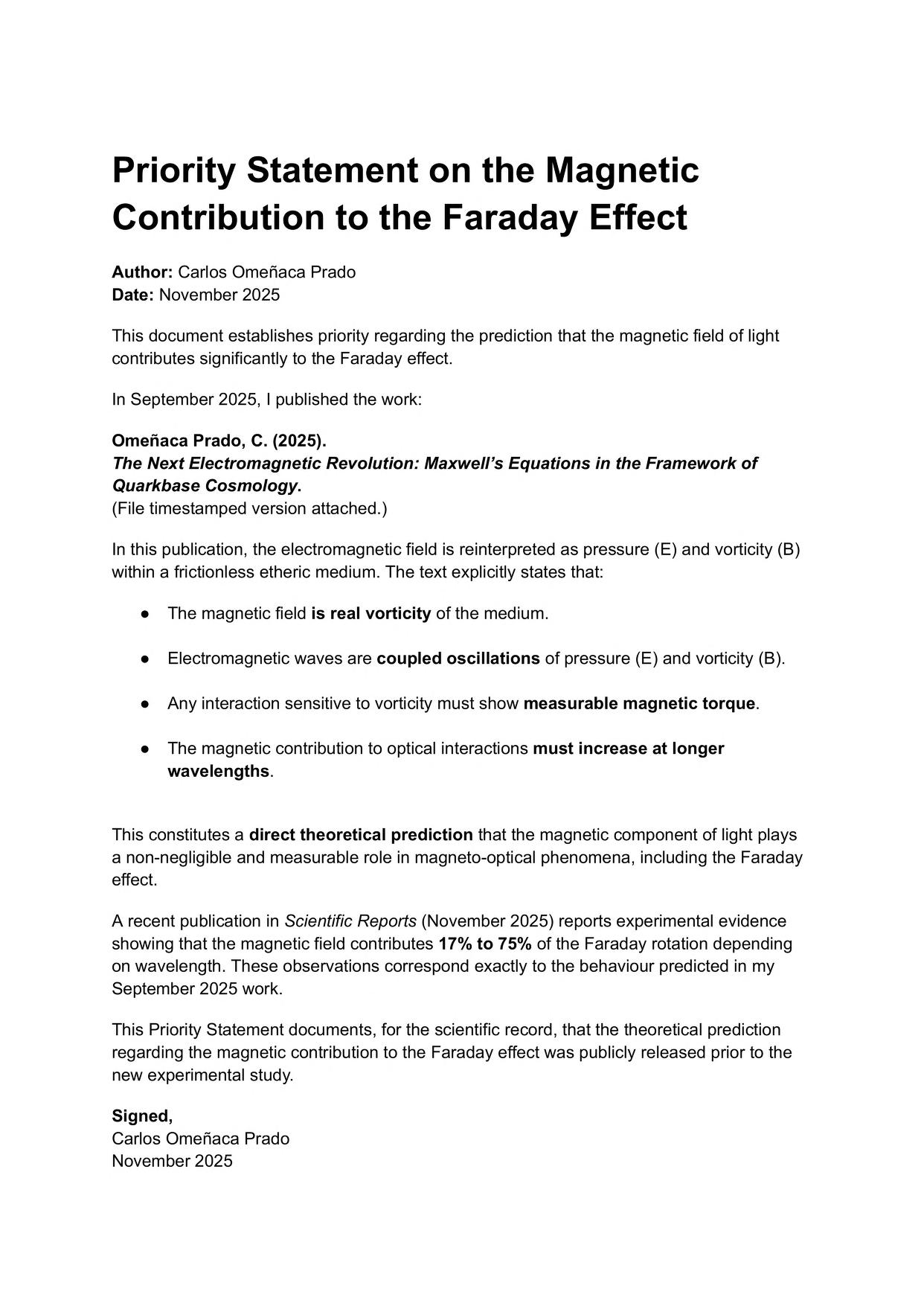
Priority Statement on the Magnetic Contribution to the Faraday Effect establishes priority for the theoretical prediction that the magnetic component of light contributes significantly to the Faraday effect. In September 2025, the work The Next Electromagnetic Revolution introduced a reinterpretation of electromagnetism in which the electric field represents pressure variations of a frictionless etheric medium and the magnetic field corresponds to its vorticity. Within this framework, any optical interaction sensitive to vorticity must display a measurable magnetic contribution, particularly at longer wavelengths. A Scientific Reports article published in November 2025 later reported experimental evidence showing that the magnetic field accounts for 17% to 75% of the observed Faraday rotation, precisely matching the predicted behaviour. This Priority Statement formally documents that the theoretical prediction was publicly released prior to the publication of the new experimental results.

DOI: 10.5281/zenodo.17718090

Date: Nov 24, 2025

Author: Carlos Omeñaca Prado
ORCID: https://orcid.org/0009-0001-9750-5827

Resource type: Preprint
Publisher: Zenodo
License: CC BY-SA 4.0 International

Related links:

List of observed phenomena unexplained by the Standard Model that the Cosmology of the Quarkbase will address one by one

List of observed phenomena

List of observed phenomena unexplained by the Standard Model that the Cosmology of the Quarkbase will address one by one summarizes a set of major physical phenomena that remain unexplained by the Standard Model and outlines how Quarkbase Cosmology proposes to address each of them. The document identifies seven key anomalies: the leptonic mass hierarchy, neutrino oscillations, color confinement, matter–antimatter asymmetry, ultra-high-energy cosmic rays, quantization at the Planck scale, and the formation of cosmic filaments. For each phenomenon, the roadmap contrasts the limitations of the Standard Model with the corresponding physical mechanism predicted by Quarkbase Cosmology, where the vacuum behaves as a structured, plasmatic medium capable of supporting resonant modes, nonlinear responses, and stability thresholds. The roadmap serves as a programmatic guide for future research, defining how the Quarkbase framework intends to tackle these open problems one by one through explicit physical mechanisms.

DOI: 10.5281/zenodo.17786064

Date: Oct 10, 2025

Author: Carlos Omeñaca Prado
ORCID: https://orcid.org/0009-0001-9750-5827

Resource type: Preprint
Publisher: Zenodo
License: CC BY-SA 4.0 International

Related links:

20 Observable Predictions of Quarkbase Cosmology

20 Observable Predictions of Quarkbase Cosmology

20 Observable Predictions of Quarkbase Cosmology presents the first complete catalogue of twenty fully testable predictions derived from Quarkbase Cosmology, a pressure-field framework in which comet behaviour, graphene transport anomalies, galactic rotation, quantum coherence, and nuclear energetics originate from a single underlying scalar field. Each prediction is formulated with explicit observables and strict falsifiability criteria. At the astrophysical scale, the framework predicts universal activation bands in interstellar comets, diagonal correlations in CO₂/H₂O ratios, pressure-memory signatures in jet alignment, and the possibility of reconstructing a 3D galactic pressure map from comet data. In condensed matter, Quarkbase invariants fix graphene’s monolayer absorbance, require superconductivity without Cooper pairs, and explain ultrahigh thermal conductivity as Ψ-transport rather than phonon behaviour. On galactic and cosmological scales, rotation curves must follow a Yukawa potential with a fixed range of ~50 kpc, large-scale filaments must trace interference modes of the Ψ-field, redshift must arise from time-varying refractive index rather than metric expansion, and supercluster sizes must satisfy a specific resonance condition. At the quantum scale, double-slit impacts must reveal self-focusing behaviour, and entanglement must persist as a continuous extended mode. In nuclear physics, fission energetics must match observations using only Ψ-pressure geometry, without invoking mass defects. Any single contradictory measurement falsifies the framework; coherent confirmation across domains would support Quarkbase Cosmology as a unified physical description.

DOI: 10.5281/zenodo.17718206

Date: Nov 26, 2025

Author: Carlos Omeñaca Prado
ORCID: https://orcid.org/0009-0001-9750-5827

Resource type: Preprint
Publisher: Zenodo
License: CC BY-SA 4.0 International

Related links:

Planck’s Constant as the Mechanical Coupling of the Etheric Plasma

Plancks Constant

Plancks Constant as the Mechanical Coupling of the Etheric Plasma derives Planck’s constant as a mechanical coupling coefficient of the etheric plasma (Ψ-field) within the Quarkbase Cosmology framework. In this model, the vacuum is a frictionless, compressible pressure medium whose longitudinal excitations define quantum behaviour. Planck’s constant emerges not as a fundamental axiom but as a measurable expression of the coupling between local pressure oscillations and the displaced-volume structure of the 13-quarkbase electron. The analysis shows that quantisation, wave–particle duality, and energy–frequency relations arise from the same underlying mechanism: the finite-speed coherence of the etheric medium. This work unifies the classical and quantum descriptions under a single physical principle.

DOI: 10.5281/zenodo.17716384

Date: Nov 15, 2025

Author: Carlos Omeñaca Prado
ORCID: https://orcid.org/0009-0001-9750-5827

Resource type: Preprint
Publisher: Zenodo
License: CC BY-SA 4.0 International

Related links:

Complex Formalism in Quarkbase Cosmology: Unified Description of Gravitational, Electromagnetic, and Quantum Interactions

Complex Formalism in Quarkbase Cosmology

Complex Formalism in Quarkbase Cosmology extends Quarkbase Cosmology into the complex domain, showing that complex notation unifies gravitational, electromagnetic, and quantum phenomena within a single analytical structure. The complex field Ψ(x,t) = A e^{i(ωt−k·x)} simultaneously represents longitudinal pressure modes and transverse vorticity of the etheric plasma, allowing Maxwell’s equations, quantum wave behaviour, and emergent gravity to be expressed as coherent manifestations of the same medium. Lorentz invariance is preserved exactly, the electromagnetic field becomes a complex pressure–vorticity wave, and quantum mechanics emerges from the statistical behaviour of the same complex ether. The formalism also derives the nucleus–electron resonance at r₍B₎ directly from phase conditions. This work establishes the complex representation as a natural and unified language for all interactions in the Quarkbase framework.

DOI: 10.5281/zenodo.17716749

Date: Nov 15, 2025

Author: Carlos Omeñaca Prado
ORCID: https://orcid.org/0009-0001-9750-5827

Resource type: Preprint
Publisher: Zenodo
License: CC BY-SA 4.0 International

Related links:

The Next Electromagnetic Revolution: Maxwell’s Equations in the Framework of Quarkbase Cosmology

The next electromagnetic revolution

The Electromagnetic Revolution reinterprets Maxwell’s equations within the Quarkbase Cosmology framework by treating the electromagnetic field as the macroscopic manifestation of a frictionless, compressible etheric plasma (Ψ-field). In this model, the electric field corresponds to pressure gradients of the medium, the magnetic field arises from its vorticity, and ε₀ and μ₀ are emergent mechanical constants rather than fundamental axioms. Electromagnetic radiation appears as transverse plasma oscillations, with longitudinal pressure modes naturally predicted. The formulation preserves Maxwell’s structure and Lorentz invariance while providing mechanical origins for charge, induction, displacement current, and wave propagation. This approach unifies electromagnetism with vacuum mechanics and enables new predictions relevant to engineered Ψ-field interactions, resonant devices, and advanced materials such as graphene.

DOI: 10.5281/zenodo.17716452

Date: Sept 01, 2025

Author: Carlos Omeñaca Prado
ORCID: https://orcid.org/0009-0001-9750-5827

Resource type: Preprint
Publisher: Zenodo
License: CC BY-SA 4.0 International

Related links:

Quantum Entanglement in the Unified Framework of the Cosmology of the Quarkbase

Quantum Entanglement

Quantum entanglement arises in the Quarkbase Cosmology framework as a collective excitation of a frictionless etheric plasma—the Ψ-field—rather than as a mysterious nonlocal interaction between isolated particles. Entangled pairs correspond to correlated Ψ-modes created jointly at the source, forming a single extended field excitation with support in two spatial regions. Measurement acts as a local projection on this global structure, producing the strong correlations observed experimentally without requiring superluminal signalling. The theory reproduces standard quantum predictions for Bell states, CHSH violation, and coincidence probabilities, while adding physical scale through the parameters of the etheric plasma (density ρₚ, compressibility K, and screening length λ = 1/mΨ). A decisive prediction emerges: if the vacuum has finite screening, Bell visibility must attenuate as V(r) ∝ e⁻ʳ/λ. Existing long-distance experiments impose strong lower bounds on λ, consistent with a highly coherent vacuum. This paper unifies quantum behaviour with medium dynamics and converts the “mysteries” of collapse and nonlocality into experimentally testable properties of a physical vacuum.

    DOI: 10.5281/zenodo.17716954

    Date: Oct 15, 2025

    Author: Carlos Omeñaca Prado
    ORCID: https://orcid.org/0009-0001-9750-5827

    Resource type: Preprint
    Publisher: Zenodo
    License: CC BY-SA 4.0 International

    Related links:

    Empirical Evidence for the Existence of an Etheric Vacuum Exhibiting Plasmatic Properties

    Empirical Evidence for the Existence of an Etheric Vacuum

    Empirical Evidence of an Ether presents an empirical and theoretical framework supporting the existence of an etheric vacuum with plasmatic characteristics, as predicted by Quarkbase Cosmology. Using the historical parameters of Tonomura’s 1989 single-electron double-slit experiment, the observed interference pattern is reproduced under the assumption that the vacuum behaves as a continuous, frictionless, compressible pressure field (Ψ). The model introduces two measurable physical quantities—the screening length λ and the decoherence rate Γφ—representing, respectively, attenuation of the ψ-field during propagation and loss of coherence due to detector coupling. Numerical simulations yield λ ≈ 5 m and Γφ ≈ 80 s⁻¹, providing an excellent quantitative match to the historical data while offering a causal, physically interpretable mechanism. The results demonstrate that the Quarkbase formulation can reproduce the same empirical evidence as standard quantum mechanics without invoking non-causal collapse postulates, suggesting that space itself possesses measurable mechanical structure.

    DOI: 10.5281/zenodo.17716796

    Date: Oct 15, 2025

    Author: Carlos Omeñaca Prado
    ORCID: https://orcid.org/0009-0001-9750-5827

    Resource type: Preprint
    Publisher: Zenodo
    License: CC BY-SA 4.0 International

    Related links: