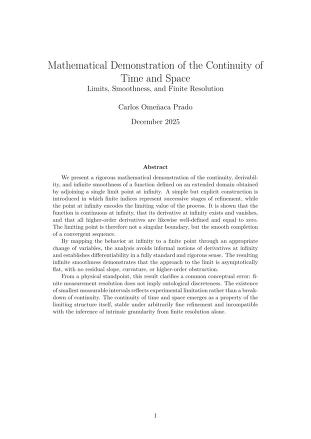
Mathematical Demonstration of the Continuity of Time and Space: Limits, Smoothness, and Finite Resolution

Mathematical Demonstration of the Continuity of Time and Space

Mathematical Demonstration of the Continuity of Time and Space presents a rigorous, self-contained analysis showing that a limit point added at infinity can be reached with full continuity, differentiability, and infinite smoothness. Using a simple refinement sequence and a standard change of variables, the work proves that the limiting value is not a singular boundary: the function is continuous at infinity, its derivative at infinity exists and equals zero, and all higher-order derivatives vanish as well. Beyond the formal result, the paper clarifies a common conceptual error in physics: finite measurement resolution does not imply ontological discreteness. “Minimum measurable” intervals reflect experimental limitation, not a breakdown of continuity. The article is written to be readable, rigorous, and directly relevant to debates on spacetime granularity, limits, and the logic of inference from finite observations.

DOI: 10.5281/zenodo.18093432

Date: Dec 26, 2025

Author: Carlos Omeñaca Prado
ORCID: https://orcid.org/0009-0001-9750-5827

Resource type: Preprint
Publisher: Zenodo
License: CC BY-SA 4.0 International

Related links:

Replacing Parameters with Physical Necessity: Quarkbase Cosmology

Replacing Parameters with Physical Necessity

Replacing Parameters with Physical Necessity presents a minimal-ontology framework that replaces parameter fitting with physical necessity. The theory is grounded on a single postulate: the physical vacuum is a continuous, non-dissipative pressure medium described by a scalar field Ψ. All physical entities arise as discrete compactations of this medium, and all interactions emerge as responses to pressure gradients and structural recomposition. From this single substrate, the framework provides unified physical explanations for: conditional irreversibility via vacuum recomposition; neutrino oscillations without intrinsic neutrino masses; the charged-lepton spectrum as resonant modes of a finite compactation; color confinement as a consequence of topological continuity; matter–antimatter asymmetry as geometric phase-orientation selection rather than CP-driven baryogenesis; and the filamentary large-scale structure of the universe as anisotropic instability of the Ψ-field, without invoking dark matter. The work is explicitly falsifiable. It states what must be false if the framework is correct and identifies decisive points where experimental evidence would refute it. No new particles, sectors, or symmetries are introduced. Instead, much of the existing theoretical scaffolding is shown to be unnecessary if a physical substrate is taken seriously. The conclusions are plain. You may take them or leave them; curiosity has been satisfied.

DOI: 10.5281/zenodo.18064740

Date: Dec 26, 2025

Author: Carlos Omeñaca Prado
ORCID: https://orcid.org/0009-0001-9750-5827

Resource type: Preprint
Publisher: Zenodo
License: CC BY-SA 4.0 International

Related links:

Conditional Irreversibility and the Emergence of the Time Arrow from Vacuum Recomposition

Conditional Irreversibility and the Emergence of the Time Arrow from Vacuum Recomposition

Conditional Irreversibility and the Emergence of the Time Arrow from Vacuum Recomposition presents a medium-based physical criterion for when reversible dynamics become irreversible. The work distinguishes mathematical time-reversal invariance from physical reconstructibility, proposing that the arrow of time emerges only when the vacuum medium can no longer recompose a previously coherent configuration after coherence is lost through dispersion, phase decorrelation, or leakage into non-recomposable vacuum modes. The paper includes a mode-coupling toy model and threshold analysis to show how irreversible behavior can arise without breaking fundamental reversibility.

DOI: 10.5281/zenodo.18041285

Date: Dec 24, 2025

Author: Carlos Omeñaca Prado
ORCID: https://orcid.org/0009-0001-9750-5827

Resource type: Preprint
Publisher: Zenodo
License: CC BY-SA 4.0 International

Related links:

Law of Antimatter Emergence in Quarkbase Cosmology

Law of Antimatter Emergence in Quarkbase derives a structural, medium-based criterion for the existence of antimatter within the framework of Quarkbase Cosmology. Antimatter is not postulated as a parallel sector nor as a remnant of a primordial symmetry, but emerges conditionally from the dynamics of the Ψ-field. A single operational principle-the conjugation of phase and orientation combined with mechanical admissibility-determines whether a given excitation admits a distinct antiparticle, is self-conjugate, or is structurally forbidden from having an antimatter counterpart. The criterion is applied systematically to leptons, neutrinos, electromagnetic modes, baryons, mesons, and composite nuclear states, yielding a unified classification that accounts for the observed pattern of antimatter and leads to explicit, falsifiable predictions beyond the Standard Model.

DOI: 10.5281/zenodo.17991454

Date: Dec 19, 2025

Author: Carlos Omeñaca Prado
ORCID: https://orcid.org/0009-0001-9750-5827

Resource type: Preprint
Publisher: Zenodo
License: CC BY-SA 4.0 International

Related links:

Emergence of the Cosmic Microwave Background in Quarkbase Cosmology

the Cosmic Microwave Background

The cosmic microwave background (CMB) presents an alternative derivation within Quarkbase Cosmology, where the physical vacuum is modeled as a continuous, frictionless medium described by a scalar pressure field Ψ. Starting from a single variational principle, the linear dynamics of the Ψ-field are derived and shown to admit a unique, dispersionless luminal mode. The statistical mechanics of this mode lead necessarily to a stationary Planckian distribution, identified with the observed CMB. The blackbody spectrum, its temperature, and its global isotropy follow as direct consequences of medium dynamics, without invoking primordial thermal equilibrium, inflation, recombination, or an expanding metric. Temperature anisotropies arise as linear transport effects induced by spatial variations of the medium, while cosmological redshift is obtained as an intrinsic temporal evolution of the vacuum that preserves the Planckian spectral form exactly. The resulting framework reproduces all kinematic observational properties of the CMB, eliminates the horizon problem by construction, and yields a self-consistent, falsifiable, non-expanding description grounded in a single physical ontology.

DOI: 10.5281/zenodo.18028189

Date: Dec 23, 2025

Author: Carlos Omeñaca Prado
ORCID: https://orcid.org/0009-0001-9750-5827

Resource type: Preprint
Publisher: Zenodo
License: CC BY-SA 4.0 International

Related links:

Chemistry of Quarkbase III: Emergence of periods and chemical groups from geometric closures of the Vacuum Pressure Field (Ψ)

Emergence of periods

Emergence of periods and chemical groups from geometric closures of the Vacuum Pressure Field (Ψ) derives the periodic structure of the chemical elements from first principles within the Quarkbase framework. Starting from a single variational functional of a vacuum pressure field, the theory produces a discrete ladder of admissible stable configurations whose finiteness, ordering, and repetition follow from geometric closure and phase-coherence constraints, without invoking electronic shells, orbitals, or empirical fitting. Chemical periods emerge as closure intervals of this ladder, while chemical groups arise from the underlying geometric and spectral structure. The observable atomic number is linked to a physical compactation charge through a single global calibration, yielding a finite periodic table with seven complete periods and a predicted subsequent closure beyond the currently known elements.

DOI: 10.5281/zenodo.17957261

Date: Dec 16, 2025

Author: Carlos Omeñaca Prado
ORCID: https://orcid.org/0009-0001-9750-5827

Resource type: Preprint
Publisher: Zenodo
License: CC BY-SA 4.0 International

Related links:

Chemistry of Quarkbase Cosmology -II: Emergence of Electronegativity

Emergence of Electronegativity

Emergence of Electronegativity derives electronegativity from first principles within Quarkbase Cosmology as an emergent, relational property of phase control in the Ψ-field. Without introducing chemical axioms, orbital postulates, or empirical fitting, electronegativity is shown to arise from nuclear phase rigidity and external-mode sensitivity. The framework naturally reproduces bond polarity, ionic and covalent limits, and periodic trends as consequences of resonance and phase coherence, providing a unified theoretical foundation for chemistry consistent with the Quarkbase Cosmology framework

DOI: 10.5281/zenodo.17930306

Date: Dec 14, 2025

Author: Carlos Omeñaca Prado
ORCID: https://orcid.org/0009-0001-9750-5827

Resource type: Preprint
Publisher: Zenodo
License: CC BY-SA 4.0 International

Related links:

Relativistic Invariance and Experimental Constraints on Quarkbase Cosmology

Relativistic Invariance and Experimental Constraints on Quarkbase Cosmology

Relativistic Invariance and Experimental Constraints on Quarkbase Cosmology presents the updated English version of a quantitative consistency analysis of Quarkbase Cosmology with current experimental tests of Lorentz invariance. Using the latest Standard-Model Extension (SME) Data Tables (January 2025), experimental bounds on the variation of the fine-structure constant and on photonic SME coefficients are translated into direct numerical constraints on the operative combination ε∂μΨ. The analysis is carried out component by component, clearly distinguishing laboratory and astrophysical limits and identifying the conditions required to suppress birefringent projections. The results show that Quarkbase Cosmology preserves effective local Lorentz invariance, remains compatible with all existing experimental constraints, and yields explicit, falsifiable predictions for future high-precision tests.

DOI: 10.5281/zenodo.17928150

Date: Dec 14, 2025

Author: Carlos Omeñaca Prado
ORCID: https://orcid.org/0009-0001-9750-5827

Resource type: Preprint
Publisher: Zenodo
License: CC BY-SA 4.0 International

Related links:

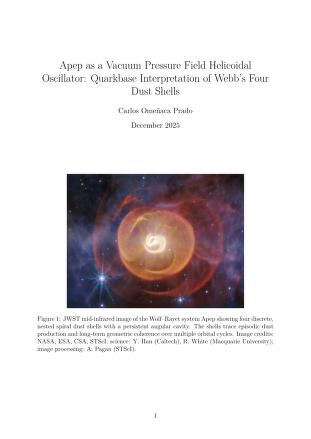
Apep as a Vacuum Pressure Field Helicoidal Oscillator: Quarkbase Interpretation of Webb’s Four Dust Shells

Apep as a Vacuum Pressure Field Helicoidal Oscillator

Apep as a Vacuum Pressure Field Helicoidal Oscillator presents a geometry-driven physical interpretation of the Wolf–Rayet system Apep based on recent JWST mid-infrared observations resolving four discrete spiral dust shells. The shell discreteness, preserved phase coherence, and persistent angular cavity indicate long-period, phase-locked dynamics inconsistent with steady-state or turbulent outflow models. Within the framework of Quarkbase Cosmology, the circumstellar environment is treated as a low-dissipation continuous medium capable of sustaining coherent helicoidal modes, with dust acting as a passive tracer of phase-coherent propagation. The work derives clear, falsifiable observational predictions and maintains a strict separation between observational facts and theoretical interpretation

DOI: 10.5281/zenodo.17925340

Date: Dec 14, 2025

Author: Carlos Omeñaca Prado
ORCID: https://orcid.org/0009-0001-9750-5827

Resource type: Preprint
Publisher: Zenodo
License: CC BY-SA 4.0 International

Related links:

Chemistry of Quarkbase Cosmology — I: Emergence of Atomic Valence

Chemistry of Quarkbase Cosmology

Chemistry of Quarkbase Cosmology — I: Emergence of Atomic Valence presents a foundational derivation of atomic valence within the Quarkbase Cosmology framework. The work shows that chemical structure arises as a geometric and dynamical consequence of stationary torsional modes of a continuous, frictionless Ψ-field, without invoking quantum-mechanical postulates, electronic orbitals, or Pauli exclusion. Discrete shell capacities (2, 8, 18, 32), valence saturation in noble gases, variable valence, and standard molecular geometries are deduced as universal, parameter-independent outcomes. Quantitative predictions for bond energies, electronegativity gradients, and spectroscopic shifts are deferred to subsequent papers, where torsional coupling strengths and Ψ-field stiffness parameters are derived

DOI: 10.5281/zenodo.17926245

Date: Dec 14, 2025

Author: Carlos Omeñaca Prado
ORCID: https://orcid.org/0009-0001-9750-5827

Resource type: Preprint
Publisher: Zenodo
License: CC BY-SA 4.0 International

Related links: