Geometry of Galaxies Explained by Quarkbase Cosmology

Geometry of Galaxies Explained by Quarkbase Cosmology

Geometry of Galaxies Explained by Quarkbase Cosmology presents a fully quantitative and physical explanation of galactic geometry within the Quarkbase Cosmology framework. Instead of treating galaxies as gravitationally bound aggregations of matter requiring dark-matter halos, the model interprets them as coherent helicoidal pressure structures generated in a frictionless etheric plasma (Ψ-field) by the long-term motion of a compact quarkic nucleus or black hole. The key mechanism is the superposition of pressure waves produced by simultaneous rotation, translation, and precession of the central compact object. This motion imprints a stable helicoidal pattern in the ether, and the visible galaxy is simply the stationary trace of that pattern. Spiral arms, bars, rings, ellipsoidal shapes, and irregular structures emerge naturally from the kinematic regime: rotation-dominated → spiral galaxies rotation ≈ translation + precession → barred spirals translation-dominated → ellipticals and lenticulars strong precession → rings, polar structures, double cores multi-source interference → irregular galaxies A full numerical integration of rotation curves using a Yukawa-screened pressure potential is presented. Screening lengths of several tens of kiloparsecs reproduce the flat rotation curves of real spiral galaxies without invoking any form of dark matter. The model yields concrete, falsifiable predictions linking observable morphology to nucleus kinematics: pitch angle, arm separation, disk thickness, luminosity scaling, and the relation between galactic size and the screening parameter λ. In this framework, a galaxy is not an evolved gravitational structure but a persistent wave pattern in the ether shaped by the motion of its central quarkic core

DOI: 10.5281/zenodo.17716164

Date: Nov 11, 2025

Author: Carlos Omeñaca Prado
ORCID: https://orcid.org/0009-0001-9750-5827

Resource type: Preprint
Publisher: Zenodo
License: CC BY-SA 4.0 International

Related links:

Filamentation and Supercluster Formation in a Three-Phase Etheric Plasma

Filamentation and Supercluster Formation in a Three-Phase Etheric Plasma

Filamentation and Supercluster Formation in a Three-Phase Etheric Plasma develops a full physical explanation of the cosmic web, superclusters, clusters, filaments, and voids using the three-phase behavior of a frictionless etheric plasma displaced by quarkbases. The central idea is that the vacuum behaves as a continuous plasma whose effective dynamics change depending solely on the local displaced-volume fraction. At extremely low displaced volume, the ether behaves as a rigid medium, producing smooth and completely empty voids. As the displaced-volume fraction increases, the plasma enters a liquid-like regime that forms clusters, sheets, and large walls. Once the threshold for compressibility is crossed, the plasma becomes effectively gas-like and collapses into long, thin pressure channels: the cosmic filaments. Where several filaments intersect, the pressure reaches true minima, generating superclusters. The work shows that these three regimes—rigid, liquid-like, and gas-like—are not different substances, but different dynamic responses of the same frictionless plasma. The cosmic web, including its largest structures, emerges naturally from this phase behavior, without dark matter, without gravitational halos, and without metric expansion. The paper explains why superclusters cannot grow beyond roughly 200–300 Mpc, why voids remain perfectly smooth, why galaxy spins align along filaments, why spirals form only in filamentary regions, and why rotation curves flatten without invoking dark matter. The ether’s transition to a filamentary state is shown to be mathematically identical to the formation of smoke filaments, scaled up by dozens of orders of magnitude. This framework provides a single mechanism that explains all large-scale cosmic structure in a coherent, testable, and falsifiable way

DOI: 10.5281/zenodo.17716344

Date: Nov 01, 2025

Author: Carlos Omeñaca Prado
ORCID: https://orcid.org/0009-0001-9750-5827

Resource type: Preprint
Publisher: Zenodo
License: CC BY-SA 4.0 International

Related links:

The Nuclear ‘mass’ defect as a Topological Property of Ether Confinement in Quarkbase Cosmology

The Nuclear mass defect as a Topological Property of Ether Confinement in Quarkbase Cosmology

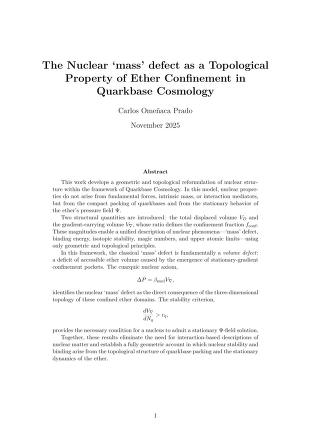
The Nuclear mass defect as a Topological Property of Ether Confinement in Quarkbase Cosmology develops a geometric and topological reformulation of nuclear structure within the framework of Quarkbase Cosmology. In this model, nuclear properties do not arise from fundamental forces, intrinsic mass, or interaction mediators, but from the compact packing of quarkbases and from the stationary behavior of the ether’s pressure field Ψ. Two structural quantities are introduced: the total displaced volume V D and the gradient-carrying volume V ∇ , whose ratio defines the confinement fraction f conf. These magnitudes enable a unified description of nuclear phenomena-‘mass’ defect, binding energy, isotopic stability, magic numbers, and upper atomic limits-using only geometric and topological principles. In this framework, the classical ‘mass’ defect is fundamentally a volume defect: a deficit of accessible ether volume caused by the emergence of stationary-gradient confinement pockets. The cuarquic nuclear axiom, ∆P = β nucl V ∇ , identifies the nuclear ‘mass’ defect as the direct consequence of the three-dimensional topology of these confined ether domains. The stability criterion, dV ∇ dN q > v q , provides the necessary condition for a nucleus to admit a stationary Ψ-field solution. Together, these results eliminate the need for interaction-based descriptions of nuclear matter and establish a fully geometric account in which nuclear stability and binding arise from the topological structure of quarkbase packing and the stationary dynamics of the ether.

DOI: 10.5281/zenodo.17772168

Date: Nov 30, 2025

Author: Carlos Omeñaca Prado
ORCID: https://orcid.org/0009-0001-9750-5827

Resource type: Preprint
Publisher: Zenodo
License: CC BY-SA 4.0 International

Related links:

Color Confinement -The Unresolved Structural Anomaly of QCD

Color Confinement-The Unresolved Structural Anomaly of QCD

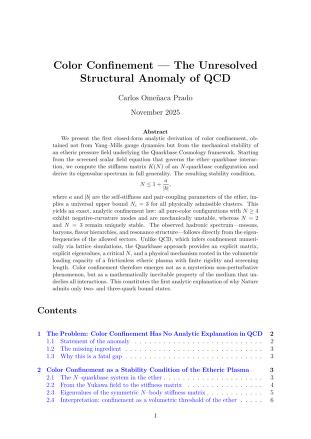
Color Confinement -The Unresolved Structural Anomaly of QCD proposes a new explanation for color confinement based on the mechanical stability of the etheric pressure field described in Quarkbase Cosmology. Instead of relying on numerical results from quantum chromodynamics, the analysis examines how multi-quark configurations load and deform the underlying vacuum medium. The key result is that only two-quark and three-quark systems remain mechanically stable, while any larger color configuration generates internal modes that destabilize the structure, preventing the formation of bound states. This provides a simple physical reason for the existence of mesons and baryons, and explains why no four-quark or higher-order pure-color states are observed in nature. The mechanism offers an analytic, medium-based perspective on confinement, complementing and extending standard QCD interpretations.

DOI: 10.5281/zenodo.17717961

Date: Nov 26, 2025

Author: Carlos Omeñaca Prado
ORCID: https://orcid.org/0009-0001-9750-5827

Resource type: Preprint
Publisher: Zenodo
License: CC BY-SA 4.0 International

Related links:

Nuclear Fission: Numerical Demonstrations of Equivalence Between the Standard Model and Quarkbase Cosmology

Nuclear Fission

Nuclear Fission: Numerical Demonstrations of Equivalence Between the Standard Model and Quarkbase Cosmology presents a direct numerical demonstration that nuclear-fission energetics—traditionally explained through mass defects and binding-energy differences—are exactly reproduced by the pressure-based formulation of Quarkbase Cosmology. Using only experimentally measured nuclear data, the analysis shows: the canonical ~200 MeV released per fission of ²³⁵U, the standard nuclear-energy density ~8×10¹³ J/kg, the liquid-drop surface-energy coefficient, and the hydrogen-level resonant energy scale are all obtained identically in both frameworks. The equivalence emerges from a single geometric identity: σ ΔA in Quarkbase (etheric surface tension × change in nuclear surface area) encodes exactly the same energy that the Standard Model attributes to Δm c². The paper computes all quantities explicitly: nuclear radii and areas, surface-area changes in asymmetric fission, effective σ consistent with the liquid-drop model, pressure–volume work in the quarkic medium, and the correspondence between E = mc², σΔA, and ΔP_bind·v_q. The key conclusion is not that the Standard Model is wrong, but that its numerical predictions can be reinterpreted as geometric pressure relaxations in a continuous etheric plasma. The numbers are identical. The interpretation is radically different. This result strengthens the consistency of Quarkbase Cosmology by showing that nuclear observables do not discriminate between the two theories—only the physical ontology does.

DOI: 10.5281/zenodo.17716663

Date: Dez 07, 2025

Author: Carlos Omeñaca Prado
ORCID: https://orcid.org/0009-0001-9750-5827

Resource type: Preprint
Publisher: Zenodo
License: CC BY-SA 4.0 International

Related links:

General Cosmology of Quarkbase (Neutrino)

General Cosmology of Quarkbase (Neutrino)

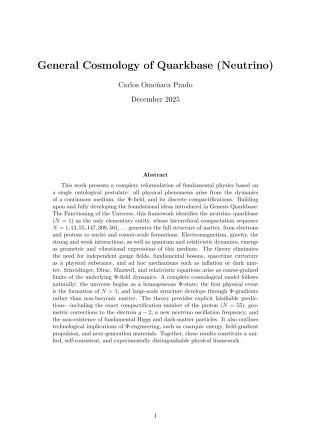
General Cosmology of Quarkbase (Neutrino) presents General Cosmology of Quarkbase (Neutrino), an expanded and refined development of the foundational framework introduced in Genesis Quarkbase: The Functioning of the Universe. The model reformulates fundamental physics through a single ontological postulate: all physical phenomena arise from the dynamics of a continuous medium—the Ψ-field—and its discrete compactifications. The neutrino–quarkbase (N = 1) is identified as the only elementary entity, while higher compactation levels 𝑁 = { 1 , 13 , 55 , 147 , 309 , 561 , …   } N={1,13,55,147,309,561,…} generate the entire structure of matter, including electrons, protons, quarks, nuclei, and cosmic formations. Electromagnetism, gravity, the strong and weak interactions, and quantum and relativistic behavior emerge as geometric and vibrational expressions of the Ψ-field. The framework eliminates independent fields, fundamental bosons, dark matter, inflation, and curvature-as-substance, replacing them with a unified Ψ-dynamic ontology. A complete cosmology follows naturally, with the universe originating from a homogeneous Ψ-state and evolving through compactation-driven structure formation. The theory provides explicit, falsifiable predictions—such as the exact compactation number of the proton (N = 55), geometric corrections to the electron 𝑔 − 2 g−2, a new neutrino oscillation mode, and the non-existence of fundamental Higgs and dark-matter particles—making it fully testable. The work also outlines technological implications of Ψ-engineering, including cuarquic energy, field-gradient propulsion, and next-generation materials. Together, these results constitute a unified, self-consistent, and experimentally distinguishable alternative to the Standard Model, General Relativity, and ΛCDM cosmology.

DOI: 10.5281/zenodo.17845483

Date: Dec 07, 2025

Author: Carlos Omeñaca Prado
ORCID: https://orcid.org/0009-0001-9750-5827

Resource type: Preprint
Publisher: Zenodo
License: CC BY-SA 4.0 International

Related links:

Strengthening Global Research Through a Refined Physical Framework

Strengthening Global Research Through a Refined Physical Framework

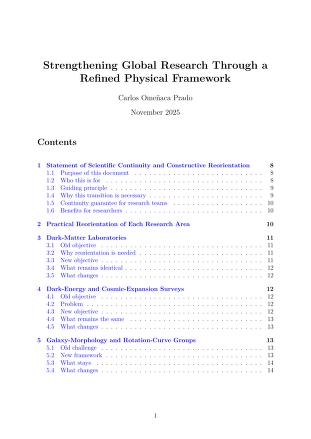
Strengthening Global Research Through a Refined Physical Framework presents a global scientific-transition framework based on a unified reinterpretation of fundamental physics in which all measurable phenomena arise from a frictionless etheric medium governed by a scalar pressure field Ψ. The objective is to preserve the continuity of all existing scientific programs —laboratories, instruments, budgets, research lines, and academic careers— while redefining only the physical interpretation of the phenomena already observed.

DOI: 10.5281/zenodo.17760434

Date: Nov 20, 2025

Author: Carlos Omeñaca Prado
ORCID: https://orcid.org/0009-0001-9750-5827

Resource type: Preprint
Publisher: Zenodo
License: CC BY-SA 4.0 International

Related links:

Priority Statement on the Magnetic Contribution to the Faraday Effect

Priority Statement on the Magnetic Contribution to the Faraday Effect

Priority Statement on the Magnetic Contribution to the Faraday Effect establishes priority for the theoretical prediction that the magnetic component of light contributes significantly to the Faraday effect. In September 2025, the work The Next Electromagnetic Revolution introduced a reinterpretation of electromagnetism in which the electric field represents pressure variations of a frictionless etheric medium and the magnetic field corresponds to its vorticity. Within this framework, any optical interaction sensitive to vorticity must display a measurable magnetic contribution, particularly at longer wavelengths. A Scientific Reports article published in November 2025 later reported experimental evidence showing that the magnetic field accounts for 17% to 75% of the observed Faraday rotation, precisely matching the predicted behaviour. This Priority Statement formally documents that the theoretical prediction was publicly released prior to the publication of the new experimental results.

DOI: 10.5281/zenodo.17718090

Date: Nov 24, 2025

Author: Carlos Omeñaca Prado
ORCID: https://orcid.org/0009-0001-9750-5827

Resource type: Preprint
Publisher: Zenodo
License: CC BY-SA 4.0 International

Related links:

List of observed phenomena unexplained by the Standard Model that the Cosmology of the Quarkbase will address one by one

List of observed phenomena

List of observed phenomena unexplained by the Standard Model that the Cosmology of the Quarkbase will address one by one summarizes a set of major physical phenomena that remain unexplained by the Standard Model and outlines how Quarkbase Cosmology proposes to address each of them. The document identifies seven key anomalies: the leptonic mass hierarchy, neutrino oscillations, color confinement, matter–antimatter asymmetry, ultra-high-energy cosmic rays, quantization at the Planck scale, and the formation of cosmic filaments. For each phenomenon, the roadmap contrasts the limitations of the Standard Model with the corresponding physical mechanism predicted by Quarkbase Cosmology, where the vacuum behaves as a structured, plasmatic medium capable of supporting resonant modes, nonlinear responses, and stability thresholds. The roadmap serves as a programmatic guide for future research, defining how the Quarkbase framework intends to tackle these open problems one by one through explicit physical mechanisms.

DOI: 10.5281/zenodo.17786064

Date: Oct 10, 2025

Author: Carlos Omeñaca Prado
ORCID: https://orcid.org/0009-0001-9750-5827

Resource type: Preprint
Publisher: Zenodo
License: CC BY-SA 4.0 International

Related links:

20 Observable Predictions of Quarkbase Cosmology

20 Observable Predictions of Quarkbase Cosmology

20 Observable Predictions of Quarkbase Cosmology presents the first complete catalogue of twenty fully testable predictions derived from Quarkbase Cosmology, a pressure-field framework in which comet behaviour, graphene transport anomalies, galactic rotation, quantum coherence, and nuclear energetics originate from a single underlying scalar field. Each prediction is formulated with explicit observables and strict falsifiability criteria. At the astrophysical scale, the framework predicts universal activation bands in interstellar comets, diagonal correlations in CO₂/H₂O ratios, pressure-memory signatures in jet alignment, and the possibility of reconstructing a 3D galactic pressure map from comet data. In condensed matter, Quarkbase invariants fix graphene’s monolayer absorbance, require superconductivity without Cooper pairs, and explain ultrahigh thermal conductivity as Ψ-transport rather than phonon behaviour. On galactic and cosmological scales, rotation curves must follow a Yukawa potential with a fixed range of ~50 kpc, large-scale filaments must trace interference modes of the Ψ-field, redshift must arise from time-varying refractive index rather than metric expansion, and supercluster sizes must satisfy a specific resonance condition. At the quantum scale, double-slit impacts must reveal self-focusing behaviour, and entanglement must persist as a continuous extended mode. In nuclear physics, fission energetics must match observations using only Ψ-pressure geometry, without invoking mass defects. Any single contradictory measurement falsifies the framework; coherent confirmation across domains would support Quarkbase Cosmology as a unified physical description.

DOI: 10.5281/zenodo.17718206

Date: Nov 26, 2025

Author: Carlos Omeñaca Prado
ORCID: https://orcid.org/0009-0001-9750-5827

Resource type: Preprint
Publisher: Zenodo
License: CC BY-SA 4.0 International

Related links: