Planck’s Constant as the Mechanical Coupling of the Etheric Plasma

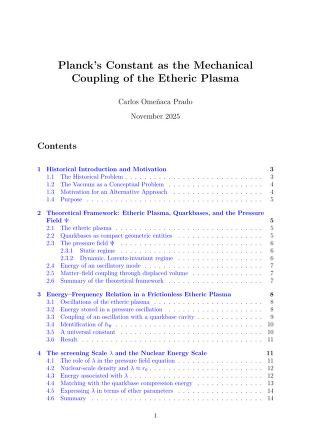
Plancks Constant

Plancks Constant as the Mechanical Coupling of the Etheric Plasma derives Planck’s constant as a mechanical coupling coefficient of the etheric plasma (Ψ-field) within the Quarkbase Cosmology framework. In this model, the vacuum is a frictionless, compressible pressure medium whose longitudinal excitations define quantum behaviour. Planck’s constant emerges not as a fundamental axiom but as a measurable expression of the coupling between local pressure oscillations and the displaced-volume structure of the 13-quarkbase electron. The analysis shows that quantisation, wave–particle duality, and energy–frequency relations arise from the same underlying mechanism: the finite-speed coherence of the etheric medium. This work unifies the classical and quantum descriptions under a single physical principle.

DOI: 10.5281/zenodo.17716384

Date: Nov 15, 2025

Author: Carlos Omeñaca Prado
ORCID: https://orcid.org/0009-0001-9750-5827

Resource type: Preprint
Publisher: Zenodo
License: CC BY-SA 4.0 International

Related links:

Complex Formalism in Quarkbase Cosmology: Unified Description of Gravitational, Electromagnetic, and Quantum Interactions

Complex Formalism in Quarkbase Cosmology

Complex Formalism in Quarkbase Cosmology extends Quarkbase Cosmology into the complex domain, showing that complex notation unifies gravitational, electromagnetic, and quantum phenomena within a single analytical structure. The complex field Ψ(x,t) = A e^{i(ωt−k·x)} simultaneously represents longitudinal pressure modes and transverse vorticity of the etheric plasma, allowing Maxwell’s equations, quantum wave behaviour, and emergent gravity to be expressed as coherent manifestations of the same medium. Lorentz invariance is preserved exactly, the electromagnetic field becomes a complex pressure–vorticity wave, and quantum mechanics emerges from the statistical behaviour of the same complex ether. The formalism also derives the nucleus–electron resonance at r₍B₎ directly from phase conditions. This work establishes the complex representation as a natural and unified language for all interactions in the Quarkbase framework.

DOI: 10.5281/zenodo.17716749

Date: Nov 15, 2025

Author: Carlos Omeñaca Prado
ORCID: https://orcid.org/0009-0001-9750-5827

Resource type: Preprint
Publisher: Zenodo
License: CC BY-SA 4.0 International

Related links:

The Next Electromagnetic Revolution: Maxwell’s Equations in the Framework of Quarkbase Cosmology

The next electromagnetic revolution

The Electromagnetic Revolution reinterprets Maxwell’s equations within the Quarkbase Cosmology framework by treating the electromagnetic field as the macroscopic manifestation of a frictionless, compressible etheric plasma (Ψ-field). In this model, the electric field corresponds to pressure gradients of the medium, the magnetic field arises from its vorticity, and ε₀ and μ₀ are emergent mechanical constants rather than fundamental axioms. Electromagnetic radiation appears as transverse plasma oscillations, with longitudinal pressure modes naturally predicted. The formulation preserves Maxwell’s structure and Lorentz invariance while providing mechanical origins for charge, induction, displacement current, and wave propagation. This approach unifies electromagnetism with vacuum mechanics and enables new predictions relevant to engineered Ψ-field interactions, resonant devices, and advanced materials such as graphene.

DOI: 10.5281/zenodo.17716452

Date: Sept 01, 2025

Author: Carlos Omeñaca Prado
ORCID: https://orcid.org/0009-0001-9750-5827

Resource type: Preprint
Publisher: Zenodo
License: CC BY-SA 4.0 International

Related links:

Quantum Entanglement in the Unified Framework of the Cosmology of the Quarkbase

Quantum Entanglement

Quantum entanglement arises in the Quarkbase Cosmology framework as a collective excitation of a frictionless etheric plasma—the Ψ-field—rather than as a mysterious nonlocal interaction between isolated particles. Entangled pairs correspond to correlated Ψ-modes created jointly at the source, forming a single extended field excitation with support in two spatial regions. Measurement acts as a local projection on this global structure, producing the strong correlations observed experimentally without requiring superluminal signalling. The theory reproduces standard quantum predictions for Bell states, CHSH violation, and coincidence probabilities, while adding physical scale through the parameters of the etheric plasma (density ρₚ, compressibility K, and screening length λ = 1/mΨ). A decisive prediction emerges: if the vacuum has finite screening, Bell visibility must attenuate as V(r) ∝ e⁻ʳ/λ. Existing long-distance experiments impose strong lower bounds on λ, consistent with a highly coherent vacuum. This paper unifies quantum behaviour with medium dynamics and converts the “mysteries” of collapse and nonlocality into experimentally testable properties of a physical vacuum.

    DOI: 10.5281/zenodo.17716954

    Date: Oct 15, 2025

    Author: Carlos Omeñaca Prado
    ORCID: https://orcid.org/0009-0001-9750-5827

    Resource type: Preprint
    Publisher: Zenodo
    License: CC BY-SA 4.0 International

    Related links:

    Empirical Evidence for the Existence of an Etheric Vacuum Exhibiting Plasmatic Properties

    Empirical Evidence for the Existence of an Etheric Vacuum

    Empirical Evidence of an Ether presents an empirical and theoretical framework supporting the existence of an etheric vacuum with plasmatic characteristics, as predicted by Quarkbase Cosmology. Using the historical parameters of Tonomura’s 1989 single-electron double-slit experiment, the observed interference pattern is reproduced under the assumption that the vacuum behaves as a continuous, frictionless, compressible pressure field (Ψ). The model introduces two measurable physical quantities—the screening length λ and the decoherence rate Γφ—representing, respectively, attenuation of the ψ-field during propagation and loss of coherence due to detector coupling. Numerical simulations yield λ ≈ 5 m and Γφ ≈ 80 s⁻¹, providing an excellent quantitative match to the historical data while offering a causal, physically interpretable mechanism. The results demonstrate that the Quarkbase formulation can reproduce the same empirical evidence as standard quantum mechanics without invoking non-causal collapse postulates, suggesting that space itself possesses measurable mechanical structure.

    DOI: 10.5281/zenodo.17716796

    Date: Oct 15, 2025

    Author: Carlos Omeñaca Prado
    ORCID: https://orcid.org/0009-0001-9750-5827

    Resource type: Preprint
    Publisher: Zenodo
    License: CC BY-SA 4.0 International

    Related links:

    Why c Exists And Ether Said: “Let There Be Light and Relativity”

    Why c exists

    Why c Exists shows that neither the universal constant c nor the gravitational constant G are fundamental axioms of nature. Both arise from a single physical mechanism: the finite reorganisation speed of a frictionless quarkic ether whose pressure and inertial density are fixed by the displaced volume of the 13-quarkbase electron. In this framework, c is the unique luminal resonant mode of the Ψ-field-the only dispersionless, self-coherent solution able to propagate without generating a wake in the ether. Its invariance defines causal structure, relativistic kinematics, and the emergent Minkowski metric. The same basal pressure P 0 that sets this propagation speed also determines the strength of gravitational coupling. By identifying the electron’s rest energy with pure compression energy E e = P 0 V disp and using the experimentally fixed Compton scale to determine V disp , the basal ether pressure satisfies P 0 ∼ 10 24 Pa. Combining this with the observed values of c and G yields a gravitational response coefficient ξκ ∼ 10-19 m-2 , expressing gravity as the extremely weak deformation of the etheric index produced by displaced-volume gradients. Under this interpretation, relativity, electromagnetism, gravity, and cosmic structure become macroscopic manifestations of the same underlying phenomenon: the finite-speed dynamics of a continuous, perfectly coherent pressure medium. The constants c and G are therefore two numerical expressions of one physical entity-the quarkic ether.

    DOI: 10.5281/zenodo.17716518

    Date: Oct 15, 2025

    Author: Carlos Omeñaca Prado
    ORCID: https://orcid.org/0009-0001-9750-5827

    Resource type: Preprint
    Publisher: Zenodo
    License: CC BY-SA 4.0 International

    Related links:

    Reconfirmation of the Relativistic Invariance of the Theory of Quarkbase (eng.): Detailed Mathematical Analysis

    Reconfirmation_of_the_Relativistic_Invariance_of_the_Theory_of_Quarkbase

    Reconfirmation of Relativistic Invariance provides the complete English edition of the detailed mathematical analysis confirming the relativistic invariance of Quarkbase Cosmology. The study derives the covariant scalar-field action, the regularised Yukawa solution for compact quarkbases, the full energy–momentum tensor, and the propagation of small perturbations within the etheric plasma.

    Both isotropic and anisotropic corrections to the phase velocity are quantified and compared against the most stringent modern constraints, including Fermi–LAT, GRB 221009A, and SME bounds. The results show that the theory preserves Lorentz invariance within experimental limits, with predicted deviations satisfying |Δc/c| < 10⁻¹⁵ and anisotropy constraints |ε| < 2×10⁻¹⁴.

    This analysis consolidates the mathematical foundation of the Quarkbase framework and reinforces its compatibility with contemporary high-precision tests of relativistic physics..

    DOI: 10.5281/zenodo.17717878

    Date: Oct 15, 2025

    Author: Carlos Omeñaca Prado
    ORCID: https://orcid.org/0009-0001-9750-5827

    Resource type: Preprint
    Publisher: Zenodo
    License: CC BY-SA 4.0 International

    Related links:

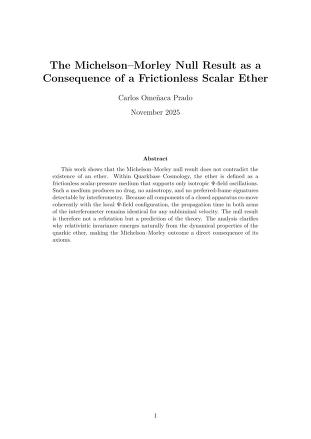
    The Michelson Morley Null Result As A Consequence Of A Frictionless Scalar Ether

    The_Michelson_Morley_Null_Result_as_a_Consequence_of_a_Frictionless_Scalar_Ethe

    The Michelson Morley Null Result As A Consequence Of A Frictionless Scalar Ether shows that the Michelson–Morley null result is not a refutation of the ether, but an explicit prediction of a frictionless scalar-pressure medium as defined in Quarkbase Cosmology. In this framework, the ether has no drag, no shear and no anisotropic response, and all components of a closed interferometer co-move coherently with the local Ψ-field configuration. As a result, both arms of the interferometer maintain identical optical paths for any subluminal velocity, making the null result unavoidable. The paper clarifies why Lorentz invariance naturally emerges from the dynamical properties of the quarkic ether, and why interferometry cannot detect such a medium.

    DOI: 10.5281/zenodo.17772569

    Date: Dez 1, 2025

    Author: Carlos Omeñaca Prado
    ORCID: https://orcid.org/0009-0001-9750-5827

    Resource type: Preprint
    Publisher: Zenodo
    License: CC BY-SA 4.0 International

    Related links:

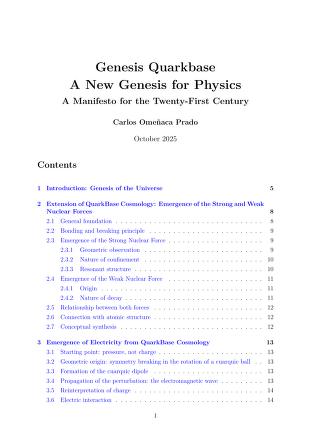
    Genesis Quarkbase (english): The Functioning of the Universe

    Genesis Quarkbase Thumbnail

    Genesis Quarkbase (English): The Functioning of the Universe is one of the foundational works of Quarkbase Cosmology, presenting a unified framework where all forces emerge from etheric-volume conservation.

    This work presents a unified physical framework in which all fundamental interactions—gravitational, electromagnetic, strong, and weak, arise from a single principle: the global conservation of etheric volume in a frictionless plasmatic medium.
    The theory derives nuclear and atomic constants (Rydberg value, hydrogen binding energy), predicts the next stable element of the periodic table (Z ≈ 155), and introduces an alternative fission mechanism based on resonance of the Ψ pressure field.
    This preprint provides the foundational narrative of Quarkbase Cosmology: the emergence of structure, resonance, and coherence from compact quarkic configurations interacting with the etheric Ψ field.

    DOI: 10.5281/zenodo.17716248

    Date: Oct 1, 2025

    Author: Carlos Omeñaca Prado
    ORCID: https://orcid.org/0009-0001-9750-5827

    Resource type: Preprint
    Publisher: Zenodo
    License: CC BY-SA 4.0 International

    Related links:

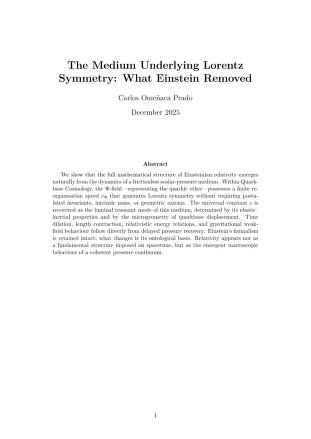
    The Medium Underlying Lorentz Symmetry: What Einstein Removed

    The Medium Underlying Lorentz Symmetry

    The Medium Underlying Lorentz Symmetry reconstructs the full mathematical structure of Einsteinian relativity from a physical medium: a frictionless scalar-pressure ether described by the field Ψ(x,t). Instead of postulating the invariance of c and Lorentz symmetry, the analysis shows that both emerge from the finite reorganisation speed of this medium. The Lorentz factor, relativistic kinematics, energy–momentum relations, and gravitational weak-field optics are recovered without invoking mass or geometric axioms. Einstein’s formalism remains valid, but its ontology is reversed: relativity becomes the macroscopic behaviour of a coherent pressure medium rather than a primitive geometric postulate.

    DOI: 10.5281/zenodo.17773957

    Date: Dec 1, 2025

    Author: Carlos Omeñaca Prado
    ORCID: https://orcid.org/0009-0001-9750-5827

    Resource type: Preprint
    Publisher: Zenodo
    License: CC BY-SA 4.0 International

    Related links: